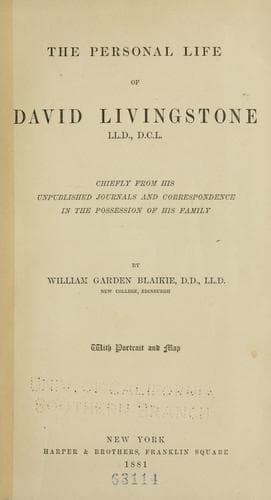
The Personal Life of David Livingstone: Chiefly from his Unpublished Journals and Correspondence in the Possession of His FamilyBlaikie, William Garden
Religion
The Personal Life of David Livingstone: Chiefly from his Unpublished Journals and Correspondence in the Possession of His Family
Blaikie, William Garden
Livingstone, David, 1813-1873
When Livingstone and Sekelétu had gone about sixty miles on the way to
the Barotse, they encountered Mpepe, Sekelétu's half-brother and secret
rival. It turned out that Mpepe had a secret plan for killing Sekelétu,
and that three times on the day of their meeting that plan was
frustrated by apparently accidental causes. On one of these occasions,
Livingstone, by covering Sekelétu, prevented him from being speared.
Mpepe's treachery becoming known, he was arrested by Sekelétu's people,
and promptly put to death. The episode was not agreeable, but it
illustrated savage life. It turned out that Mpepe favored the
slave-trade, and was closely engaged with certain Portuguese traders in
intrigues for establishing and extending it. Had Sekelétu been killed,
Livingstone's enterprise would certainly have been put an end to, and
very probably likewise Livingstone himself.
The party, numbering about one hundred and sixty, proceeded up the
beautiful river which on his former visit Livingstone had first known as
the Seshéke, but which was called by the Barotse the Liambai or
Leeambye. The term means "the large river," and Luambeji, Luambesi,
Ambezi, Yimbezi, and Zambezi are names applied to it at different parts
of its course. In the progress of their journey they came to the town of
the father of Mpepe, where, most unexpectedly, Livingstone encountered a
horrible scene. Mpepe's father and another headman were known to have
favored the plan for the murder of Sekelétu, and were therefore objects
of fear to the latter. When all were met, and Mpepe's father was
questioned why he did not stop his son's proceedings, Sekelétu suddenly
sprang to his feet and gave the two men into custody. All had been
planned beforehand. Forthwith they were led away, surrounded by
Sekelétu's warriors, all dream of opposition on their part being as
useless as interference would have been on Livingstone's. Before his
eyes he saw them hewn to; pieces with axes, and cast into the river to
be devoured by the alligators. Within two hours of their arrival the
whole party had left the scene of this shocking tragedy, Livingstone
being so horrified that he could not remain. He did his best to show the
sin of blood-guiltiness, and bring before the people the scene of the
Last Judgment, which was the only thing that seemed to make any
impression.
Farther on his way he had an interview with Ma-mochisane, the daughter
of Sebituane who had resigned in favor of Sekelétu. He was the first
white man she had ever seen. The interview was pleasing and not without
touches of womanly character; the poor woman had felt an _embarras de
richesses_ in the matter of husbands, and was very uncomfortable when
married women complained of her taking their spouses from them. Her soul
recoiled from the business; she wished to have a husband of her own and
to be like other women.
Public-domain text, read in full here on John Shaqi.
Reviews
Reviews
No reviews yet
Be the first to share your thoughts on this work.
Elsewhere in the archive
Join the Discussion
Join the discussion
Sign in to leave a comment or review.
Sign InorCreate an account