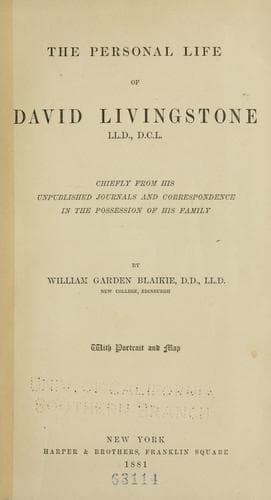
The Personal Life of David Livingstone: Chiefly from his Unpublished Journals and Correspondence in the Possession of His FamilyBlaikie, William Garden
Religion
The Personal Life of David Livingstone: Chiefly from his Unpublished Journals and Correspondence in the Possession of His Family
Blaikie, William Garden
Livingstone, David, 1813-1873
and self-respect which he had begun to learn at the hand of his mother,
and which he practiced all his life. Even in the matter of personal
cleanliness and dress he was uniformly most attentive in his wanderings
among savages. "I feel certain," he said, "that the lessons of
cleanliness rigidly instilled by my mother in childhood helped to
maintain that respect which these people entertain for European ways."
The course of the journey was first along the river Zambesi, as he had
gone before with Sekelétu, to its junction with the Leeba, then along
the Leeba to the country of Lobale on the left and Londa on the right.
Then, leaving the canoes, he traveled on oxback first N.N.W. and then W.
till he reached St. Paul de Loanda on the coast. His Journal, like the
published volume, is full of observations on the beauty and wonderful
capacity and productiveness of the country through which he passed after
leaving the river. Instinctively he would compare it with Scotland. A
beautiful valley reminds him of his native vale of Clyde, seen from the
spot where Mary Queen of Scots saw the battle of Langside; only the
Scottish scene is but a miniature of the much greater and richer
landscape before him. At the sight of the mountains he would feel his
Highland blood rushing through him, banishing all thoughts of fever and
fatigue. If only the blessings of the gospel could be spread among the
people, what a glorious land it would become! But alas for the people!
In most cases they were outwardly very repulsive. Never seen without a
spear or a club in their hands, the men seemed only to delight in
plunder and slaughter, and yet they were utter cowards. Their mouths
were full of cursing and bitterness. The execrations they poured on each
other were incredible. In very wantonness, when they met they would pelt
each other with curses, and then perhaps burst into a fit of laughter.
The women, like the men, went about in almost total nudity, and seemed
to know no shame. So reckless were the chiefs of human life, that a man
might be put to death for a single distasteful word; yet sometimes there
were exhibitions of very tender feeling. The headman of a village once
showed him, with much apparent feeling, the burnt house of a child of
his, adding,--"She perished in it, and we have all removed from our own
huts and built here round her, in order to weep over her grave." From
some of the people he received great kindness; others were quite
different. Their character, in short, was a riddle, and would need to be
studied more. But the prevalent aspect of things was both distressing
and depressing. If he had thought of it continually, he would have
become the victim of melancholy. It was a characteristic of his large
and buoyant nature, that, besides having the resource of spiritual
thought, he was able to make use of another divine corrective to such a
tendency, to find delightful recreation in science, and especially in
Public-domain text, read in full here on John Shaqi.
Reviews
Reviews
No reviews yet
Be the first to share your thoughts on this work.
Elsewhere in the archive
Join the Discussion
Join the discussion
Sign in to leave a comment or review.
Sign InorCreate an account