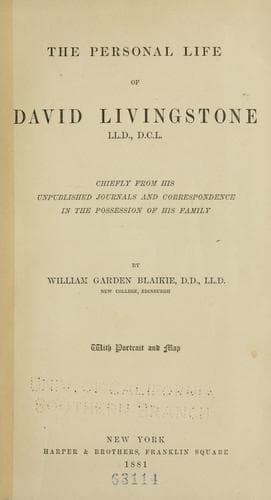
The Personal Life of David Livingstone: Chiefly from his Unpublished Journals and Correspondence in the Possession of His FamilyBlaikie, William Garden
Religion
The Personal Life of David Livingstone: Chiefly from his Unpublished Journals and Correspondence in the Possession of His Family
Blaikie, William Garden
Livingstone, David, 1813-1873
natural history, and by this means turn the mind away for a time from
the dark scenes of man's depravity.
The people all seemed to recognize a Supreme Being; but it was only
occasionally, in times of distress, that they paid Him homage. They had
no love for Him like that of Christians for Jesus--only terror. Some of
them, who were true negroes, had images, simple but grotesque. Their
strongest belief was in the power of medicines acting as charms. They
fully recognized the existence of the soul after death. Some of them
believed in the metamorphosis of certain persons into alligators or
hippopotamuses, or into lions. This belief could not be shaken by any
arguments--at least on the part of man. The negroes proper interested
him greatly; they were numerous, prolific, and could not be extirpated.
He almost regretted that Mr. Moffat had translated the Bible into
Sichuana. That language might die out; but the negro might sing, "Men
may come and men may go, but I go on for ever."
The incessant attacks of fever from which Livingstone suffered in this
journey, the continual rain occurring at that season of the year, the
return of the affection of the throat for which he had got his uvula
excised, and the difficulty of speaking to tribes using different
dialects, prevented him from, holding his Sunday services as regularly
as before. Such entries in his Journal as the following are but
too frequent:
"_Sunday, 19th_.--Sick all Sunday and unable to move. Several
of the people were ill too, so that I could do nothing but
roll from side to side in my miserable little tent, in which,
with all the shade we could give it, the thermometer stood
upward of 90°."
But though little able to preach, Livingstone made the most of an
apparatus which in some degree compensated his lack of speech--a
magic-lantern which his friend, a former fellow-traveler, Mr. Murray,
had given him. The pictures of Abraham offering up Isaac, and other
Bible scenes, enabled him to convey important truths in a way that
attracted the people. It was, he says, the only service he was ever
asked to repeat. The only uncomfortable feeling it raised was on the
part of those who stood on the side where the slides were drawn out.
They were terrified lest the figures, as they passed along, should take
possession of them, entering like spirits into their bodies!
Public-domain text, read in full here on John Shaqi.
Reviews
Reviews
No reviews yet
Be the first to share your thoughts on this work.
Elsewhere in the archive
Join the Discussion
Join the discussion
Sign in to leave a comment or review.
Sign InorCreate an account