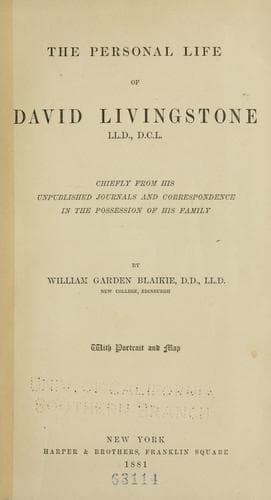
The Personal Life of David Livingstone: Chiefly from his Unpublished Journals and Correspondence in the Possession of His FamilyBlaikie, William Garden
Religion
The Personal Life of David Livingstone: Chiefly from his Unpublished Journals and Correspondence in the Possession of His Family
Blaikie, William Garden
Livingstone, David, 1813-1873
The configuration of intertropical South Africa had long been with him a
subject of earnest study, and now he had come clearly to the conclusion
that the middle part was a table-land, depressed, however, in the
centre, and flanked by longitudinal ridges on the east and west; that
originally the depressed centre had contained a vast accumulation of
water, which had found ways of escape through fissures in the encircling
fringe of mountains, the result of volcanic action or of earthquakes.
The Victoria Falls presented the most remarkable of these fissures, and
thus served to verify and complete his theory. The great lakes in the
great heart of South Africa were the remains of the earlier accumulation
before the fissures were formed. Lake 'Ngami, large though it was, was
but a little fraction of the vast lake that had once spread itself over
the south. This view of the structure of South Africa he now found, from
a communication which reached him at Linyanti, had been anticipated by
Sir Roderick Murchison, who in 1852 had propounded it to the
Geographical Society. Livingstone was only amused at thus losing the
credit of his discovery; he contented himself with a playful remark on
his being "cut out" by Sir Roderick. But the coincidence of views was
very remarkable, and it lay at the foundation of that brotherlike
intimacy and friendship which ever marked his relation with Murchison.
One important bearing of the geographical fact was this; it was evident
that while the low districts were unhealthy, the longitudinal ridges by
which they were fringed were salubrious. Another of its bearings was,
that it would help them to find the course and perhaps the sources of
the great rivers, and thus facilitate commercial and missionary
operations. The discovery of the two healthy ridges, which made him so
unwilling to die at the mouth of the Loangwa, gave him new hopes for
missions and commerce.
These and other matters connected with the state of the country formed
the subject of regular communications to the Geographical Society.
Between Loanda and Quilimane, six despatches were written at different
points[45]. Formerly, as we have seen, he had written through a Fellow
of the Society, his friend and former fellow-traveler, Captain, now
Colonel Steele; but as the Colonel had been called on duty to the
Crimea, he now addressed his letters to his countryman, Sir Roderick
Murchison. Sir Roderick was charmed with the compliment, and was not
slow to turn it to account, as appears from the following letter, the
first of very many communications which he addressed to Livingstone:
[Footnote 45: The dates were Pungo Andongo, 24th December, 1864;
Cabango, 17th May, 1855; Linyanti, October 16, 1855; Chanyuni, 25th
January, 1856; Tette, 4th March, 1856; Quilimane, 23d May, 1856.]
"16 BELGRAVE SQUARE, _October 2_, 1855.
Public-domain text, read in full here on John Shaqi.
Reviews
Reviews
No reviews yet
Be the first to share your thoughts on this work.
Elsewhere in the archive
Join the Discussion
Join the discussion
Sign in to leave a comment or review.
Sign InorCreate an account