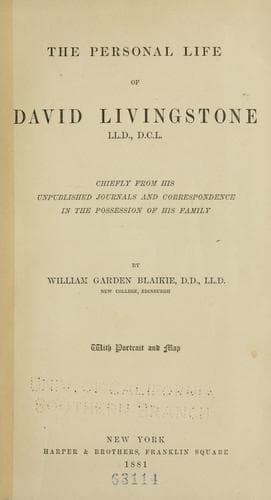
The Personal Life of David Livingstone: Chiefly from his Unpublished Journals and Correspondence in the Possession of His FamilyBlaikie, William Garden
Religion
The Personal Life of David Livingstone: Chiefly from his Unpublished Journals and Correspondence in the Possession of His Family
Blaikie, William Garden
Livingstone, David, 1813-1873
"MY DEAR SIR,--Your most welcome letter reached me after I
had made a tour in the Highlands, and just as the meeting of
the British Association for the Advancement of Science
commenced.
"I naturally communicated your despatch to the Geographical
section of that body, and the reading of it called forth an
unanimous expression of admiration of your labors and
researches.
"In truth, you will long ago, I trust, have received the
cordial thanks of all British geographers for your
unparalleled exertions, and your successful accomplishment of
the greatest triumph in geographical research which has been
effected in our times.
"I rejoice that I was the individual in the Council of the
British Geographical Society who proposed that you should
receive our first gold medal of the past session, and I need
not say that the award was made by an unanimous and
cordial vote.
"Permit me to thank you sincerely for having selected me as
your correspondent in the absence of Colonel Steele, and to
assure you that I shall consider myself as much honored, as I
shall certainly be gratified, by every fresh line which you
may have leisure to write to me.
"Anxiously hoping that I may make your personal acquaintance,
and that you may return to us in health to receive the
homage of all geographers,--I remain, my dear Sir, yours most
faithfully,
"RODCK* I. MURCHISON,"
The other subject that chiefly occupied Livingstone's mind at this time
was missionary labor. This, like all other labor, required to be
organized, on the principle of making the very best use of all the force
that was or could be contributed for missionary effort. With his fair,
open mind, he weighed the old method of monastic establishments, and,
_mutatis mutandis_, he thought something of the kind might be very
useful. He thought it unfair to judge of what these monasteries were in
their periods of youth and vigor, from the rottenness of their decay.
Modern missionary stations, indeed, with their churches, schools, and
hospitals, were like Protestant monasteries, conducted on the more
wholesome principle of family life; but they wanted stability; they had
not farms like monasteries, and hence they required to depend on the
mother country. From infancy to decay they were pauper institutions. In
Livingstone's judgment they needed to have more of the
self-supporting element:
Public-domain text, read in full here on John Shaqi.
Reviews
Reviews
No reviews yet
Be the first to share your thoughts on this work.
Elsewhere in the archive
Join the Discussion
Join the discussion
Sign in to leave a comment or review.
Sign InorCreate an account