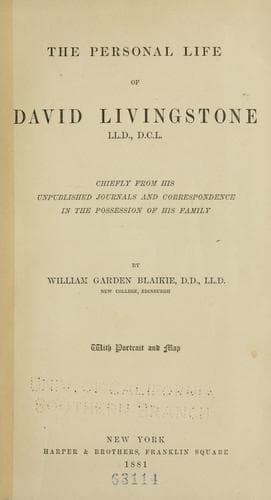
The Personal Life of David Livingstone: Chiefly from his Unpublished Journals and Correspondence in the Possession of His FamilyBlaikie, William Garden
Religion
The Personal Life of David Livingstone: Chiefly from his Unpublished Journals and Correspondence in the Possession of His Family
Blaikie, William Garden
Livingstone, David, 1813-1873
Some of the remarks in these passages, and also in the extracts which
we have given from his Journals, are of profound interest, as indicating
air important transition from the ideas of a mere missionary laborer to
those of a missionary general or statesman. In the early part of his
life he deemed it his joy and his honor to aim at the conversion of
individual souls, and earnestly did he labor and pray for that, although
his visible success was but small. But as he gets better acquainted with
Africa, and reaches a more commanding point of view, he sees the
necessity for other work. The continent must be surveyed, healthy
localities for mission-stations must be found, the temptations to a
cursed traffic in human flesh must be removed, the products of the
country must be turned to account; its whole social economy must be
changed. "The accomplishment of such objects, even in a limited degree,
would be an immense service to the missionary; it would be such a
preparing of his way that a hundred years hence the spiritual results
would be far greater than if all the effort now were concentrated on
single souls. To many persons it appeared as if dealing with individual
souls were the only proper work of a missionary, and as if one who had
been doing such work would be lowering himself if he accepted any other.
Livingstone never stopped to reason as to which was the higher or the
more desirable work; he felt that Providence was calling him to be less
of a missionary journeyman and more of a missionary statesman; but the
great end was ever the same--
"THE END OF THE GEOGRAPHICAL FEAT is ONLY
THE BEGINNING OF THE ENTERPRISE."
Livingstone reached the Portuguese settlement of Tette on the 3d March,
1856, and the "civilized breakfast" which the commandant, Major Sicard,
sent forward to him, on his way, was a luxury like Mr. Gabriel's bed at
Loanda, and made him walk the last eight miles without the least
sensation of fatigue, although the road was so rough that, as a
Portuguese soldier remarked, it was like "to tear a man's life out of
him." At Loanda he had heard of the battle of the Alma; after being in
Tette a short time he heard of the fall of Sebastopol and the end of the
Crimean War. He remained in Tette till the 23d April, detained by an
attack of fever, receiving extraordinary kindness from the Governor,
and, among other tokens of affection, a gold chain for his daughter
Agnes, the work of an inhabitant of the town. These gifts were duly
acknowledged. It was at this place that Dr. Livingstone left his
Makololo followers, with instructions to wait for him till he should
return from England. Well entitled though he was to a long rest, he
deliberately gave up the possibility of it, by engaging to return for
his black companions.
Public-domain text, read in full here on John Shaqi.
Reviews
Reviews
No reviews yet
Be the first to share your thoughts on this work.
Elsewhere in the archive
Join the Discussion
Join the discussion
Sign in to leave a comment or review.
Sign InorCreate an account