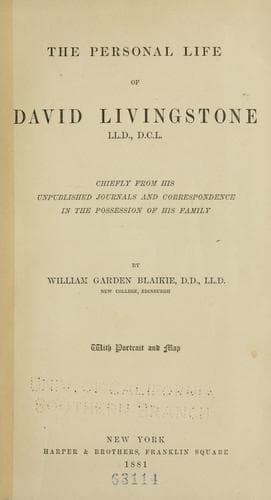
The Personal Life of David Livingstone: Chiefly from his Unpublished Journals and Correspondence in the Possession of His FamilyBlaikie, William Garden
Religion
The Personal Life of David Livingstone: Chiefly from his Unpublished Journals and Correspondence in the Possession of His Family
Blaikie, William Garden
Livingstone, David, 1813-1873
In the case of Dr. Livingstone, rest meant merely change of employment,
and while resting and recovering from fever, he wrote a large budget of
long and interesting letters. One of these was addressed to the King of
Portugal: it affords clear evidence that, however much Livingstone felt
called to reprobate the deeds of some of his subordinates, he had a
respectful feeling for the King himself, a grateful sense of the
kindness received from his African subjects, and an honest desire to aid
the wholesome development of the Portuguese colonies. It refutes, by
anticipation, calumnies afterward circulated to the effect that
Livingstone's real design was to wrest the Portuguese settlements in
Africa from Portugal, and to annex them to the British Crown. He refers
most gratefully to the great kindness and substantial aid he had
received from His Majesty's subjects, and is emboldened thereby to
address him on behalf of Africa. He suggests certain agricultural
products--especially wheat and a species of wax--that might be
cultivated with enormous profit. A great stimulus might be given to the
cultivation of other products--coffee, cotton, sugar, and oil. Much had
been done for Angola, but with little result, because the colonists'
leant on Government instead of trusting to themselves. Illegitimate
traffic (the slave-trade) was not at present remunerative, and now was
the time to make a great effort to revive wholesome enterprise. A good
road into the interior would be a great boon. Efforts to provide roads
and canals had failed for want of superintendents. Dr. Livingstone named
a Portuguese engineer who would superintend admirably. The fruits of the
Portuguese missions were still apparent, but there was a great want of
literature, of books.
"It will not be denied," concludes the letter, "that those
who, like your Majesty, have been placed over so many human
souls, have a serious responsibility resting upon them in
reference to their future welfare. The absence also of
Portuguese women In the colony is a circumstance which seems
to merit the attention of Government for obvious reasons. And
if any of these suggestions should lead to the formation of a
middle class of free laborers, I feel sure that Angola would
have cause to bless your Majesty to the remotest time."
Public-domain text, read in full here on John Shaqi.
Reviews
Reviews
No reviews yet
Be the first to share your thoughts on this work.
Elsewhere in the archive
Join the Discussion
Join the discussion
Sign in to leave a comment or review.
Sign InorCreate an account