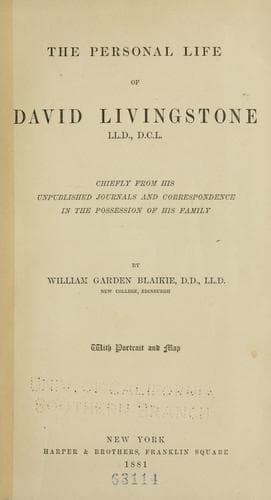
The Personal Life of David Livingstone: Chiefly from his Unpublished Journals and Correspondence in the Possession of His FamilyBlaikie, William Garden
Religion
The Personal Life of David Livingstone: Chiefly from his Unpublished Journals and Correspondence in the Possession of His Family
Blaikie, William Garden
Livingstone, David, 1813-1873
Dr. Livingstone has often been accused of claiming for himself the
credit of discoveries made by others, of writing as if he had been the
first to traverse routes in which he had really been preceded by the
Portuguese. Even were it true that now and then an obscure Portuguese
trader or traveler reached spots that lay in Dr. Livingstone's
subsequent route, the fact would detract nothing from his merit, because
he derived not a tittle of benefit from their experience, and what he
was concerned about was, not the mere honor of being first at a place,
as if he had been running a race, but to make it known to the world, to
bring it into the circuit of commerce and Christianity, and thus place
it under the influence of the greatest blessings. But even as to being
first, Livingstone was careful not to claim anything that was really due
to others. Writing from Tette to Sir Roderick in March, 1856, he says:
"It seems proper to mention what has been done in former times in the
way of traversing the continent, and the result of my inquiries leads to
the belief that the honor belongs to our country." He refers to the
brave attempt of Captain José da Roga, in 1678, to penetrate from
Benguela to the Rio da Senna, in which attempt, however, so much
opposition was encountered that he was compelled to return. In 1800,
Lacerda revived the project by proposing a chain of forts along the
banks of the Coanza. In 1815, two black traders showed the possibility
of communication from east to west, by bringing to Loanda communications
from the Governor of Mozambique. Some Arabs and Moors went from the East
Coast to Benguela, and with a view to improve the event, "a million of
Reis (£142) and an honorary captaincy in the Portuguese army was offered
to any one who would accompany them back--but none went." The journey
had several times been performed by Arabs.
Public-domain text, read in full here on John Shaqi.
Reviews
Reviews
No reviews yet
Be the first to share your thoughts on this work.
Elsewhere in the archive
Join the Discussion
Join the discussion
Sign in to leave a comment or review.
Sign InorCreate an account