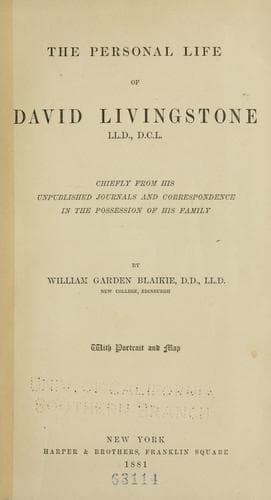
The Personal Life of David Livingstone: Chiefly from his Unpublished Journals and Correspondence in the Possession of His FamilyBlaikie, William Garden
Religion
The Personal Life of David Livingstone: Chiefly from his Unpublished Journals and Correspondence in the Possession of His Family
Blaikie, William Garden
Livingstone, David, 1813-1873
We are not, however, inclined to think that this trial was due to the
cause which Livingstone assigned,--his want of experience, and want of
command over the English tongue. He was by no means an inexperienced
writer. He had written large volumes of Journals, memoirs for the
Geographical Society, articles on African Missions, letters for the
Missionary Society, and private letters without end, each usually as
long as a pamphlet. He was master of a clear, simple, idiomatic style,
well fitted to record the incidents of a journey--sometimes poetical in
its vivid pictures, often brightening into humor, and sometimes
deepening into pathos. Viewing it page by page, the style of the
_Missionary Travels_ is admirable, the chief defect being want of
perspective; the book is more a collection of pieces than an organized
whole: a fault inevitable, perhaps, in some measure, from its nature,
but aggravated, as we believe, by the haste and pressure under which it
had to be written. In his earlier private letters, Livingstone, in his
single-hearted desire to rouse the world on the subject of Africa, used
to regret that he could not write in such a way as to command general
attention: had he been master of the flowing periods of the _Edinburgh
Review,_ he thought he could have done much more good. In point of fact,
if he had had the pen of Samuel Johnson, or the tongue of Edmund Burke,
he would not have made the impression he did. His simple style and plain
speech were eminently in harmony with his truthful, unexaggerating
nature, and showed that he neither wrote nor spoke for effect, but
simply to utter truth. What made his work of composition irksome was, on
the one hand, the fear that he was not doing it well, and on the other,
the necessity of doing it quickly. He had always a dread that his
English was not up to the critical mark, and yet he was obliged to hurry
on, and leave the English as it dropped from his pen. He had no time to
plan, to shape, to organize; the architectural talent could not be
brought into play. Add to this that he had been so accustomed to
open-air life and physical exercise, that the close air and sedentary
attitude of the study must have been exceedingly irksome; so that it is
hardly less wonderful that his health stood the confinement of
book-making in England, than that it survived the tear and wear, labor
and sorrow, of all his journeys in Africa.
An extract from a letter to Mr. Maclear, on the eve of his beginning his
book (21st January, 1857), will show how his thoughts were running:
Public-domain text, read in full here on John Shaqi.
Reviews
Reviews
No reviews yet
Be the first to share your thoughts on this work.
Elsewhere in the archive
Join the Discussion
Join the discussion
Sign in to leave a comment or review.
Sign InorCreate an account