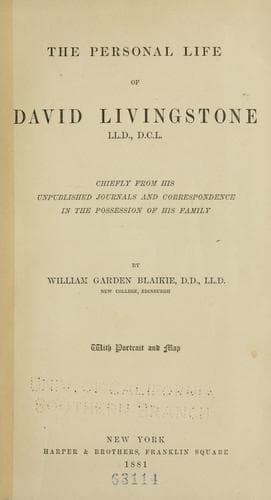
The Personal Life of David Livingstone: Chiefly from his Unpublished Journals and Correspondence in the Possession of His FamilyBlaikie, William Garden
Religion
The Personal Life of David Livingstone: Chiefly from his Unpublished Journals and Correspondence in the Possession of His Family
Blaikie, William Garden
Livingstone, David, 1813-1873
"I begin to-morrow to write my book, and as I have a large
party of men (110) waiting for me at Tette, and I promised to
join them in April next, you will see I shall have enough to
do to get over my work here before the end of the month....
Many thanks for all the kind things you said at the Cape Town
meeting. Here they laud me till I shut my eyes, for only
trying to do my duty. They ought to vote thanks to the Boers
who set me free to discover the fine new country. They were
determined to shut the country, and I was determined to open
it. They boasted to the Portuguese that they had expelled two
missionaries, and outwitted themselves rather. I got the gold
medal, as you predicted, and the freedom of the town of
Hamilton, which insures me protection from the payment of
jail fees if put in prison!"
In writing his book, he sometimes worked in the house of a friend, but
generally in a London or suburban lodging, often with his children about
him, and all their noise; for, as in the Blantyre mill, he could
abstract his attention from sounds of whatever kind, and go on calmly
with his work. Busy though he was, this must have been one of the
happiest times in his life. Some of his children still remember his
walks and romps with them in the Barnet woods, near which they lived
part of the time--how he would suddenly plunge into the ferny thicket,
and set them looking for him, as people looked for him afterward when he
disappeared in Africa, coming out all at once at some unexpected corner
of the thicket. One of his greatest troubles was the penny post. People
used to ask him the most frivolous questions. At first he struggled to
answer them, but in a few weeks he had to give this up in despair. The
simplicity of his heart is seen in the childlike joy with which he
welcomes the early products of the spring. He writes to Mr. Maclear
that, one day at Professor Owen's, they had "seen daisies, primroses,
hawthorns, and robin-redbreasts. Does not Mrs. Maclear envy us? It was
so pleasant."
But a better idea of his mode of life at home will be conveyed by the
notes of some of the friends with whom he stayed. For that purpose, we
resume the recollections of Dr. Risdon Bennett:
Public-domain text, read in full here on John Shaqi.
Reviews
Reviews
No reviews yet
Be the first to share your thoughts on this work.
Elsewhere in the archive
Join the Discussion
Join the discussion
Sign in to leave a comment or review.
Sign InorCreate an account