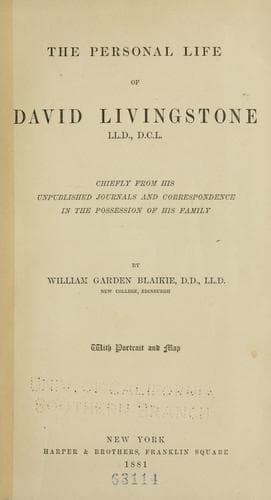
The Personal Life of David Livingstone: Chiefly from his Unpublished Journals and Correspondence in the Possession of His Family — John Shaqi
The Personal Life of David Livingstone: Chiefly from his Unpublished Journals and Correspondence in the Possession of His FamilyBlaikie, William Garden
Religion
The Personal Life of David Livingstone: Chiefly from his Unpublished Journals and Correspondence in the Possession of His Family
Blaikie, William Garden
Livingstone, David, 1813-1873
The home in which David Livingstone grew up was bright and happy, and
presented a remarkable example of all the domestic virtues. It was ruled
by an industry that never lost an hour of the six days, and that
welcomed and honored the day of rest; a thrift that made the most of
everything, though it never got far beyond the bare necessaries of life;
a self-restraint that admitted no stimulant within the door, and that
faced bravely and steadily all the burdens of life; a love of books that
showed the presence of a cultivated taste, with a fear of God that
dignified the life which it moulded and controlled. To the last David
Livingstone was proud of the class from which he sprang. When the
highest in the land were showering compliments on him, he was writing to
his old friends of "my own order, the honest poor," and trying, by
schemes of colonization and otherwise, to promote their benefit. He
never had the least hankering for any title or distinction that would
have seemed to lift him out of his own class; and it was with perfect
sincerity that on the tombstone which he placed over the resting-place
of his parents in the cemetery of Hamilton, he expressed his feelings in
these words, deliberately refusing to change the "and" of the last line
into "but":
TO SHOW THE RESTING-PLACE OF
NEIL LIVINGSTONE,
AND AGNES HUNTER, HIS WIFE,
AND TO EXPEESS THE THANKFULNESS TO GOD
OF THEIR CHILDREN,
JOHN, DAVID, JANET, CHARLES, AND AGNES,
FOR POOR AND PIOUS PARENTS.
David Livingstone's birthday was the 19th March, 1813. Of his early
boyhood there is little to say, except that he was a favorite at home.
The children's games were merrier when he was among them, and the
fireside brighter. He contributed constantly to the happiness of the
family. Anything of interest that happened to him he was always ready to
tell them. The habit was kept up in after-years. When he went to study
in Glasgow, returning on the Saturday evenings, he would take his place
by the fireside and tell them all that had occurred during the week,
thus sharing his life with them. His sisters still remember how they
longed for these Saturday evenings. At the village school he received
his early education. He seems from his earliest childhood to have been
of a calm, self-reliant nature. It was his father's habit to lock the
door at dusk, by which time all the children were expected to be in the
house. One evening David had infringed this rule, and when he reached
the door it was barred. He made no cry nor disturbance, but having
procured a piece of bread, sat down contentedly to pass the night on the
doorstep. There, on looking out, his mother found him. It was an early
application of the rule which did him such service in later days, to
make the best of the least pleasant situations. But no one could yet
have thought how the rule was to be afterward applied. Looking back to
this period, Livingstone might have said, in the words of the old
Scotch ballad:
Public-domain text, read in full here on John Shaqi.
Reviews
Reviews
No reviews yet
Be the first to share your thoughts on this work.
Join the Discussion
Join the discussion
Sign in to leave a comment or review.
Sign InorCreate an account