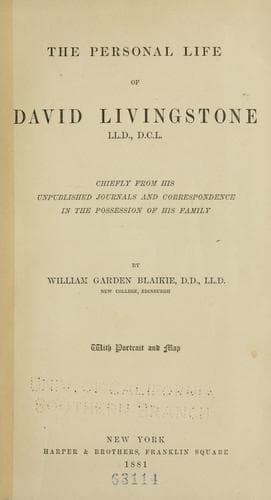
The Personal Life of David Livingstone: Chiefly from his Unpublished Journals and Correspondence in the Possession of His FamilyBlaikie, William Garden
Religion
The Personal Life of David Livingstone: Chiefly from his Unpublished Journals and Correspondence in the Possession of His Family
Blaikie, William Garden
Livingstone, David, 1813-1873
On Dr. Livingstone explaining that, while he fully appreciated these
views, it did not appear to him consistent with duty to be receiving the
pay of a working missionary while engaged to a considerable extent in
scientific exploration, Mr. Braithwaite expressed anew his sympathy for
his feelings, and respect for his decision, but not as one quite
convinced:
"Thy heart is bound, as I truly believe, in its inmost depths
to the service of Christ. This is the 'one thing' which,
through all, it is thy desire to keep in view. And my fear
has been lest the severing of thy connection with a
recognized religious body should lead any to suppose that thy
Christian interests were in the least weakened; or that thou
wast now going forth with any lower aim than the advancement
of the Redeemer's kingdom. Such a circumstance would be
deeply to be regretted, for thy character is now, if I may so
speak, not thy own, but the common property, in a certain
sense, of British Christianity, and anything which tended to
lower thy high standing would cast a reflection on the
general cause."
The result showed that Mr. Braithwaite was right as to the impression
likely to be made on the public; but the contents of this volume amply
prove that the impression was wrong.
Dr. Livingstone had said at Quilimane that if it were the will of God
that he should do the work of exploration and settlement of stations
which was indispensable to the opening up of Africa, but which the
Directors did not then seem to wish him to undertake, the means would be
provided from some other quarter. At the meeting of the British
Association in Dublin, a movement was begun for getting the Government
to aid him. The proposal was entertained favorably by the Government,
and practically settled before the end of the year. In February, 1858,
Dr. Livingstone received a formal commission, signed by Lord Clarendon,
Foreign Secretary, appointing him Her Majesty's Consul at Quilimane for
the Eastern Coast and the independent districts in the interior, and
commander of an expedition for exploring Eastern and Central Africa. Dr.
Livingstone accepted the appointment, and during the last part of his
stay in England was much engaged in arranging for the expedition. A
paddle steamer of light draught was procured for the navigation of the
Zambesi, and the various members of the expedition received their
appointments. These were--Commander Bedingfield, R.N., Naval Officer;
John Kirk, M.D., Botanist and Physician; Mr. Charles Livingstone,
brother of Dr. Livingstone, General Assistant and Secretary; Mr. Richard
Thornton, Practical Mining Geologist; Mr. Thomas Baines, Artist and
Storekeeper; and Mr. George Rae, Ship Engineer; and whoever afterward
might join the expedition were required to obey Dr. Livingstone's
directions as leader.
Public-domain text, read in full here on John Shaqi.
Reviews
Reviews
No reviews yet
Be the first to share your thoughts on this work.
Elsewhere in the archive
Join the Discussion
Join the discussion
Sign in to leave a comment or review.
Sign InorCreate an account