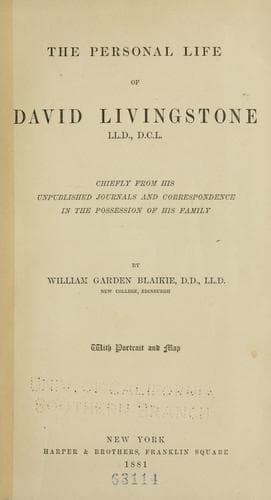
The Personal Life of David Livingstone: Chiefly from his Unpublished Journals and Correspondence in the Possession of His FamilyBlaikie, William Garden
Religion
The Personal Life of David Livingstone: Chiefly from his Unpublished Journals and Correspondence in the Possession of His Family
Blaikie, William Garden
Livingstone, David, 1813-1873
"We managed your affair very nicely," Lord Palmerston said to
Livingstone at a reception at Lady Palmerston's on the 12th December.
"Had we waited till the usual time when Parliament should be asked, it
would have been too late." Lord Shaftesbury, at the reception, assured
him that the country would do everything for him, and congratulated him
on going out in the way now settled. So did the Lord Chancellor
(Cranworth), Sir Culling Eardley, and Mr. Calcraft, M.P.
Dr. Livingstone was on the most friendly terms with the Portuguese
Ambassador, the Count de Lavradio, who ever avowed the highest respect
for himself, and a strong desire to help him in his work. To get this
assurance turned into substantial assistance appeared to Livingstone to
be of the very highest importance. Unless strong influence were brought
to bear on the local Portuguese Governors in Africa, his scheme would be
wrecked. The Portuguese Ambassador was then at Lisbon, and Livingstone
had resolved to go there, to secure the influence from headquarters
which was so necessary. The Prince Consort had promised to introduce him
to his cousin, the King of Portugal. There were, however, some obstacles
to his going. Yellow fever was raging at Lisbon, and moreover, time was
precious, and a little delay might lead to the loss of a season on the
Zambesi. At Lady Palmerston's reception, Lord Palmerston had said to him
that Lord Clarendon might manage the Portuguese affair without his going
to Lisbon. A day or two after, Livingstone saw Lord Clarendon, who
confirmed Lord Palmerston's opinion, and assured him that when Lavradio
returned, the affair would be settled. The Lisbon journey was
accordingly given up. The Count returned to London before Livingstone
left, and expressed a wish to send a number of Portuguese agents along
with him. But to this both Lord Clarendon and he had the strongest
objections, as complicating the expedition. Livingstone was furnished
with letters from the Portuguese Government to the local Governors,
instructing them to give him all needful help. But when he returned to
the Zambesi he found that these public instructions were strangely
neutralized and reversed by some unseen process. He himself believed to
the last in the honest purpose of the King of Portugal, but he had not
the same confidence in the Government. From some of the notes written to
him at this time by friends who understood more of diplomacy than he
did, we can see that little actual help was expected from the local
Governors in the Portuguese settlements, one of these friends expressing
the conviction that "the sooner those Portuguese dogs-in-the-manger are
eaten, up, body and bones, by the Zulu Caffres, the better."
Public-domain text, read in full here on John Shaqi.
Reviews
Reviews
No reviews yet
Be the first to share your thoughts on this work.
Elsewhere in the archive
Join the Discussion
Join the discussion
Sign in to leave a comment or review.
Sign InorCreate an account