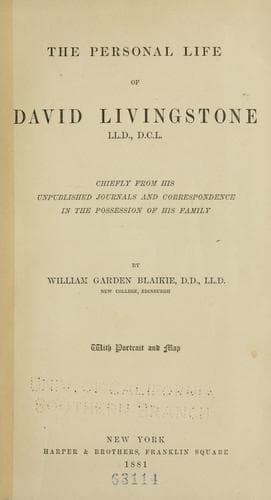
The Personal Life of David Livingstone: Chiefly from his Unpublished Journals and Correspondence in the Possession of His FamilyBlaikie, William Garden
Religion
The Personal Life of David Livingstone: Chiefly from his Unpublished Journals and Correspondence in the Possession of His Family
Blaikie, William Garden
Livingstone, David, 1813-1873
The first important fact in the history of the Expedition was the
discovery of the advantage of the Kongone entrance of the Zambesi, the
best of all the mouths of the river for navigation. Soon after a site
was fixed on as a depôt, and while the luggage and stores were being
landed at it, there occurred an unfortunate collision with the naval
officer, who tendered his resignation. At first Livingstone declined to
accept of it, but on its being tendered a second time he allowed the
officer to go. It vexed him to the last degree to have this difference
so early, nor did he part with the officer without much forbearance and
anxiety to ward off the breach. In his despatches to Government the
whole circumstances were fully detailed. Letters to Mr. Maclear and
other private friends give a still more detailed narrative. In a few
quarters blame was cast upon him, and in the Cape newspapers the affair
was much commented on. In due time there came a reply from Lord
Malmesbury, then Foreign Secretary, dated 26th April, 1859, to the
effect that after full inquiry by himself, and after consulting with the
Admiralty, his opinion was that the officer had failed to clear himself,
and that Dr. Livingstone's proceedings were fully approved. Livingstone
had received authority to stop the pay of any member of the Expedition
that should prove unsatisfactory; this, of course, subjected his conduct
to the severer criticism.
When the officer left, Livingstone calmly took his place, adding the
charge of the ship to his other duties. This step would appear alike
rash and presumptuous, did we not know that he never undertook any work
without full deliberation, and did we not remember that in the course of
three sea-voyages which he had performed he had had opportunities of
seeing how a ship was managed--opportunities of which, no doubt, with
his great activity of mind, he had availed himself most thoroughly. The
facility with which he could assume a new function, and do its duties as
if he had been accustomed to it all his life, was one of the most
remarkable things about him. His chief regret in taking the new burden
was, that it would limit his intercourse with the natives, and prevent
him from doing as much missionary work as he desired. Writing soon after
to Miss Whately, of Dublin, he says: "It was imagined we could not help
ourselves, but I took the task of navigating on myself, and have
conducted the steamer over 1600 miles, though as far as my likings go, I
would as soon drive a cab in November fogs in London as be 'skipper' in
this hot sun; but I shall go through with it as a duty." To his friend
Mr. Young he makes humorous reference to his awkwardness in nautical
language: "My great difficulty is calling out 'starboard' when I mean
'port,' and feeling crusty when I see the helmsman putting the helm the
wrong way."
Public-domain text, read in full here on John Shaqi.
Reviews
Reviews
No reviews yet
Be the first to share your thoughts on this work.
Elsewhere in the archive
Join the Discussion
Join the discussion
Sign in to leave a comment or review.
Sign InorCreate an account