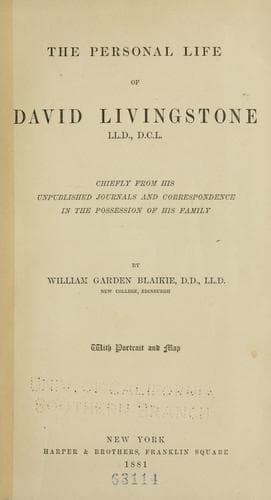
The Personal Life of David Livingstone: Chiefly from his Unpublished Journals and Correspondence in the Possession of His FamilyBlaikie, William Garden
Religion
The Personal Life of David Livingstone: Chiefly from his Unpublished Journals and Correspondence in the Possession of His Family
Blaikie, William Garden
Livingstone, David, 1813-1873
Another difficulty arose from the state of the country north of the
Zambesi, in consequence of the natives having rebelled against the
Portuguese and being in a state of war. Livingstone was cautioned that
he would be attacked if he ventured to penetrate into the country. He
resolved to keep out of the quarrel, but to push on in spite of it. At
one time his party, being mistaken for Portuguese, were on the point of
being fired on, but on Livingstone shouting out that they were English
the natives let them alone. On reaching Tette he found his old followers
in ecstasies at seeing him; the Portuguese Government had done nothing
for them, but Major Sicard, the excellent Governor of Tette, had helped
them to find employment and maintain themselves. Thirty had died of
small-pox; six had been killed by an unfriendly chief. When the
survivors saw Dr. Livingstone, they said: "The Tette people often
taunted us by saying, 'Your Englishman will never return;' but we
trusted you, and now we shall sleep." It gave Livingstone a new hold on
them and on the natives generally, that he had proved true to his
promise, and had come back as he had said. As the men had found ways of
living at Tette, Livingstone was not obliged to take them to their home
immediately.
One of his first endeavors after reaching Tette was to ascertain how far
the navigation of the Zambesi was impeded by the rapids at Kebrabasa,
between twenty and thirty miles above Tette, which he had heard of but
not seen on his journey from Linyanti to Quilimane. The distance was
short and the enterprise apparently easy, but in reality it presented
such difficulties as only his dogged perseverance could have overcome.
After he had been twice at the rapids, and when he believed he had seen
the whole, he accidentally learned, after a day's march on the way home,
that there was another rapid which he had not yet seen. Determined to
see all, he returned, with Dr. Kirk and four Makololo, and it was on
this occasion that his followers, showing the blisters on their feet
burst by the hot rocks, told him, when he urged them to make another
effort, that hitherto they had always believed he had a heart, but now
they saw he had none, and wondered if he were mad. Leaving them, he and
Dr. Kirk pushed on alone; but their boots and clothes were destroyed; in
three hours they made but a mile. Next day, however, they gained their
point and saw the rapid. It was plain to Dr. Livingstone that had he
taken this route in 1856, instead of through the level Shidina country,
he must have perished. The party were of opinion that when the river was
in full flood the rapids might be navigated, and this opinion was
confirmed on a subsequent visit paid by Mr. Charles Livingstone and Mr.
Baines during the rainy season. But the "Ma-Robert" with its single
engine had not power to make way. It was resolved to apply to Her
Majesty's Government for a more suitable vessel to carry them up the
country, stores and all.
Public-domain text, read in full here on John Shaqi.
Reviews
Reviews
No reviews yet
Be the first to share your thoughts on this work.
Elsewhere in the archive
Join the Discussion
Join the discussion
Sign in to leave a comment or review.
Sign InorCreate an account