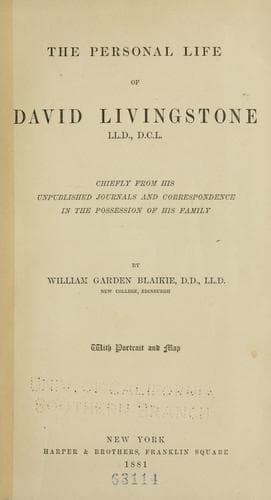
The Personal Life of David Livingstone: Chiefly from his Unpublished Journals and Correspondence in the Possession of His FamilyBlaikie, William Garden
Religion
The Personal Life of David Livingstone: Chiefly from his Unpublished Journals and Correspondence in the Possession of His Family
Blaikie, William Garden
Livingstone, David, 1813-1873
It was about his twentieth year that the great spiritual change took
place which determined the course of Livingstone's future life. But
before this time he had earnest thoughts on religion. "Great pains," he
says in his first book, "had been taken by my parents to instill the
doctrines of Christianity into my mind, and I had no difficulty in
understanding the theory of a free salvation by the atonement of our
Saviour; but it was only about this time that I began to feel the
necessity and value of a personal application of the provisions of that
atonement to my own case[5]." Some light is thrown on this brief account
in a paper submitted by him to the Directors of the London Missionary
Society in 1838, in answer to a schedule of queries sent down by them
when he offered himself as a missionary for their service. He says that
about his twelfth year he began to reflect on his state as a sinner, and
became anxious to realize the state of mind that flows from the
reception of the truth into the heart. He was deterred, however, from
embracing the free offer of mercy in the gospel, by a sense of
unworthiness to receive so great a blessing, till a supernatural change
should be effected in him by the Holy Spirit. Conceiving it to be his
duty to wait for this, he continued expecting a ground of hope within,
rejecting meanwhile the only true hope of the sinner, the finished work
of Christ, till at length his convictions were effaced, and his feelings
blunted. Still his heart was not at rest; an unappeased hunger remained,
which no other pursuit could satisfy.
[Footnote 5: _Missionary Travels_, p.4]
In these circumstances he fell in with Dick's _Philosophy of a Future
State_. The book corrected his error, and showed him the truth. "I saw
the duty and inestimable privilege _immediately_ to accept salvation by
Christ. Humbly believing that through sovereign mercy and grace I have
been enabled so to do, and having felt in some measure its effects on my
still depraved and deceitful heart, it is my desire to show my
attachment to the cause of Him who died for me by devoting my life to
his service."
Public-domain text, read in full here on John Shaqi.
Reviews
Reviews
No reviews yet
Be the first to share your thoughts on this work.
Join the Discussion
Join the discussion
Sign in to leave a comment or review.
Sign InorCreate an account