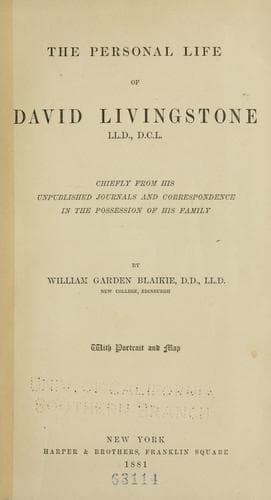
The Personal Life of David Livingstone: Chiefly from his Unpublished Journals and Correspondence in the Possession of His FamilyBlaikie, William Garden
Religion
The Personal Life of David Livingstone: Chiefly from his Unpublished Journals and Correspondence in the Possession of His Family
Blaikie, William Garden
Livingstone, David, 1813-1873
It has sometimes been represented, in view of such facts as have just
been recorded, that Livingstone was imperious and despotic in the
management of other men, otherwise he and his comrades would have got on
better together. The accusation, even at first sight, has an air of
improbability, for Livingstone's nature was most kindly, and it was the
aim of his life to increase enjoyment. In explanation of the friction on
board his ship it must be remembered that his party were a sort of
scratch crew brought together without previous acquaintance or knowledge
of each other's ways; that the heat and the mosquitoes, the delays, the
stoppages on sandbanks, the perpetual struggle for fuel[59], the
monotony of existence, with so little to break it, and the irritating
influence of the climate, did not tend to smooth their tempers or
increase the amenities of life. The malarious climate had a most
disturbing effect. No one, it is said, who has not experienced it, could
imagine the sensation of misery connected with the feverish attacks so
common in the low districts. And Livingstone had difficulties in
managing his countrymen he had not in managing the natives. He was so
conscientious, so deeply in earnest, so hard a worker himself, that he
could endure nothing that seemed like playing or trifling with duty.
Sometimes, too, things were harshly represented to him, on which a
milder construction might have been put. One of those with whom he
parted at this time afterward rejoined the Expedition, his pay being
restored on Livingstone's intercession. Those who continued to enjoy his
friendship were never weary of speaking of his delightful qualities as a
companion in travel, and the warm sunshine which he had the knack of
spreading around.
[Footnote 59: This was incredible. Livingstone wrote to his friend José
Nunes that it took all hands a day and a half to cut one day's fuel.]
A third trip up the Shiré was made in August, and on the 16th of
September Lake Nyassa was discovered. Livingstone had no doubt that he
and his party were the discoverers; Dr. Roscher, on whose behalf a claim
was subsequently made, was two months later, and his unfortunate murder
by the natives made it doubtful at what point he reached the lake. The
discovery of Lake Nyassa, as well as Lake Shirwa, was of immense
importance, because they were both parallel to the ocean, and the whole
traffic of the regions beyond must pass by this line. The configuration
of the Shiré Valley, too, was favorable to colonization. The valley
occupied three different levels. First there was a plain on the level of
the river, like that of the Nile, close and hot. Rising above this to
the east there was another plain, 2000 feet high, three or four miles
broad, salubrious and pleasant. Lastly, there was a third plain 3000
feet above the second, positively cold. To find such varieties of
climate within a few miles of each other was most interesting.
Public-domain text, read in full here on John Shaqi.
Reviews
Reviews
No reviews yet
Be the first to share your thoughts on this work.
Elsewhere in the archive
Join the Discussion
Join the discussion
Sign in to leave a comment or review.
Sign InorCreate an account