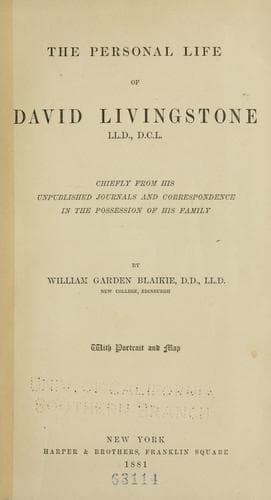
The Personal Life of David Livingstone: Chiefly from his Unpublished Journals and Correspondence in the Possession of His FamilyBlaikie, William Garden
Religion
The Personal Life of David Livingstone: Chiefly from his Unpublished Journals and Correspondence in the Possession of His Family
Blaikie, William Garden
Livingstone, David, 1813-1873
In other respects the region opened up was remarkable. There was a great
amount of fertile land, and the products were almost endless. The people
were industrious; in the Upper Shiré, notwithstanding a great love of
beer, they lived usually to a great age. Cleanliness was not a universal
virtue; the only way in which the Expedition could get rid of a
troublesome follower was by threatening to wash him. The most
disagreeable thing in the appearance of the women was their
lip-ornament, consisting of a ring of ivory or tin, either hollow or
made into a cup, inserted in the upper lip. Dr. Livingstone used to give
full particulars of this fearful practice, having the idea that the
taste of ladies at home in dress and ornament was not free from similar
absurdity; or, as he wrote at this time to the Royal Geographical
Society of Vienna, in acknowledging the honor of being made a
corresponding member, "because our own ladies, who show so much virtuous
perseverance with their waists, may wish to try lip-ornament too." In
regard to the other sex, he informed the same Society: "I could see
nothing encouraging for the gentlemen who are anxious to prove that we
are all descended from a race that wore tails."
In the highland regions of the Shiré Valley, the party were distinctly
conscious of an increase of energy, from the more bracing climate. Dr.
Livingstone was thoroughly convinced that these highlands of the Shiré
Valley were the proper locality for commercial and missionary stations.
Thus one great object of the Expedition was accomplished. In another
point of view, this locality would be highly serviceable for stations.
It was the great pathway for conveying slaves from the north and
northwest to Zanzibar. Of this he had only too clear evidence in the
gangs of slaves whom he saw marched along from time to time, and whom he
would have been most eager to release had he known of any way of
preventing them from falling again into the hands of the slave-sellers.
In this region Englishmen "might enjoy good health, and also be of
signal benefit, by leading the multitude of industrious inhabitants to
cultivate cotton, maize, sugar, and other valuable produce, to exchange
for goods of European manufacture, at the same time teaching them, by
precept and example, the great truths of our holy religion."
Water-carriage existed all the way from England, with the exception of
the Murchison Cataracts, along which a road of forty miles might easily
be made. A small steamer on the lake would do more good in suppressing
the slave-trade than half-a-dozen men-of-war in the ocean. If the
Zambesi could be opened to commerce the bright vision of the last ten
years would be realized, and the Shiré Valley and banks of the Nyassa
transformed into the garden of the Lord.
Public-domain text, read in full here on John Shaqi.
Reviews
Reviews
No reviews yet
Be the first to share your thoughts on this work.
Elsewhere in the archive
Join the Discussion
Join the discussion
Sign in to leave a comment or review.
Sign InorCreate an account