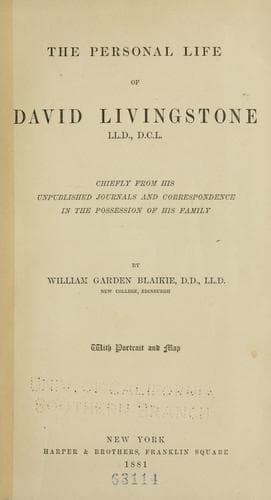
The Personal Life of David Livingstone: Chiefly from his Unpublished Journals and Correspondence in the Possession of His FamilyBlaikie, William Garden
Religion
The Personal Life of David Livingstone: Chiefly from his Unpublished Journals and Correspondence in the Possession of His Family
Blaikie, William Garden
Livingstone, David, 1813-1873
But far more tragical was the news of the missionaries who had gone from
the London Missionary Society to Linyanti, to labor among Sekelétu's
people. Mr. and Mrs. Helmore and several of his party had succumbed to
fever, and the survivors had retired. Dr. Livingstone was greatly
distressed, and not a little hurt, because he had not heard a word about
the mission, nor been asked advice about any of the arrangements. If
only the Helmores and their comrades had followed the treatment
practiced by him so often, and in this very valley at this time by his
brother Charles, they would probably have recovered. All spoke kindly of
Mr. Helmore, who had quite won the hearts of the people. Knowing their
language, he had at once begun to preach, and some of the young men at
Seshéke were singing the hymns he had taught them. Rumors had gone
abroad that some of the missionaries had been poisoned. In some quarters
blame was cast on Livingstone for having misled the Society as to the
character of Sekelétu and his disposition toward missionaries; but
Livingstone satisfied himself that, though the missionaries had been
neglected no foul play had taken place; fever alone had caused the
deaths, and want of skill in managing the people had brought the
remainder of the troubles. One piece of good news which he heard at
Linyanti was that his old friend Sechéle was doing well. He had a
Hanoverian missionary, nine tribes were under him, and the schools were
numerously attended.
Writing to Dr. Moffat, 10th August, 1860, from Zambesi Falls, he says:
"With great sorrow we learned the death of our much-esteemed
friends, Mr. and Mrs. Helmore, two days ago. We were too late
to be of any service, for the younger missionaries had
retired, probably dispirited by the loss of their leader. It
is evident that the fever when untreated is as fatal now as
it proved in the case of Commodore Owen's officers in this
river, or in the great Niger Expedition. And yet what poor
drivel was poured forth when I adopted energetic measures for
speedily removing any Europeans out of the Delta. We were not
then aware that the remedy which was first found efficacious
in our own little Thomas on Lake 'Ngami, in 1850, and that
cured myself and attendants during my solitary journeyings,
was a certain cure for the disease, without loss of strength
in Europeans generally. This we now know by ample experience
to be the case. Warburg's drops, which have a great
reputation in India, here cause profuse perspiration only,
and the fever remains uncured. With our remedy, of which we
make no secret, a man utterly prostrated is roused to resume
his march next day. I have sent the prescription to John, as
I doubt being able to go so far South as Mosilikatse's.
Public-domain text, read in full here on John Shaqi.
Reviews
Reviews
No reviews yet
Be the first to share your thoughts on this work.
Elsewhere in the archive
Join the Discussion
Join the discussion
Sign in to leave a comment or review.
Sign InorCreate an account