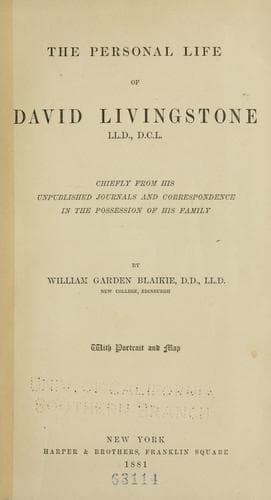
The Personal Life of David Livingstone: Chiefly from his Unpublished Journals and Correspondence in the Possession of His FamilyBlaikie, William Garden
Religion
The Personal Life of David Livingstone: Chiefly from his Unpublished Journals and Correspondence in the Possession of His Family
Blaikie, William Garden
Livingstone, David, 1813-1873
Again the grand Victoria Falls are reached, and Charles Livingstone, who
has seen Niagara, gives the preference to Mosi-oa-tunya. By the route
which they took, they would have passed the Falls at twenty miles'
distance, but Dr. Livingstone could not resist the temptation to show
them to his companions. All his former computations as to their size
were found to be considerably within the mark; instead of a thousand
yards broad they were more than eighteen hundred, and whereas he had
said that the height of fall was about 100 feet, it turned out to be
310. His habit of keeping within the mark in all his statements of
remarkable things was thus exemplified.
On coming among his old friends the Makololo, he found them in low
spirits owing to protracted drought, and Sekelétu was ill of leprosy. He
was in the hands of a native doctress, who was persuaded to suspend her
treatment, and the lunar caustic applied by Drs. Livingstone and Kirk
had excellent effects[60]. On going to Linyanti, Dr. Livingstone found
the wagon and other articles which he had left there in 1853, safe and
sound, except from the effects of weather and the white ants. The
expressions of kindness and confidence toward him on the part of the
natives greatly touched him. The people were much disappointed at not
seeing Mrs. Livingstone and the children. But this confidence was the
result of his way of dealing with them. "It ought never to be forgotten
that influence among the heathen can be acquired only by patient
continuance in well-doing, and that good manners are as necessary among
barbarians as among the civilized." The Makololo were the most
interesting tribe that Dr. Livingstone had ever seen. While now with
them he was unwearied in his efforts for their spiritual good. In his
Journal we find these entries:
[Footnote 60: In 1864, while residing at Newstead Abbey, and writing his
book, _The Zambesi and its Tributaries_, Dr. Livingstone heard of the
death of Sekelétu.]
"_September_ 2, 1860.--On Sunday evening went over to the
people, giving a general summary of Christian faith by the
life of Christ. Asked them to speak about it afterward.
Replied that these things were above them--they could not
answer me. I said if I spoke of camels and buffaloes tamed,
they understood, though they had never seen them; why not
perceive the story of Christ, the witnesses to which refused
to deny it, though killed for maintaining it? Went on to
speak of the resurrection. All were listening eagerly to the
statements about this, especially when they heard that they,
too, must rise and be judged. Lerimo said, 'This I won't
believe.' 'Well, the guilt lies between you and Jesus,' This
always arrests attention. Spoke of blood shed by them; the
conversation continued till they said, 'It was time for me to
cross, for the river was dangerous at night.'"
Public-domain text, read in full here on John Shaqi.
Reviews
Reviews
No reviews yet
Be the first to share your thoughts on this work.
Elsewhere in the archive
Join the Discussion
Join the discussion
Sign in to leave a comment or review.
Sign InorCreate an account