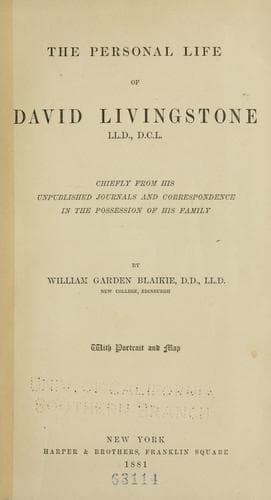
The Personal Life of David Livingstone: Chiefly from his Unpublished Journals and Correspondence in the Possession of His FamilyBlaikie, William Garden
Religion
The Personal Life of David Livingstone: Chiefly from his Unpublished Journals and Correspondence in the Possession of His Family
Blaikie, William Garden
Livingstone, David, 1813-1873
Livingstone has told us that the village of Blantyre, with its
population of two thousand souls, contained some characters of sterling
worth and ability, who exerted a most beneficial influence on the
children and youth of the place by imparting gratuitous religious
instruction. The names of two of the worthiest of these are given,
probably because they stood highest in his esteem, and he owed most to
them, Thomas Burke and David Hogg. Essentially alike, they seem to have
been outwardly very different. Thomas Burke, a somewhat wild youth, had
enlisted early in the army. His adventures and hairbreadth escapes in
the Forty-second, during the Peninsular and other wars, were marvelous,
and used to be told in after-years to crowds of wondering listeners. But
most marvelous was the change of heart that brought him back an intense
Christian evangelist, who, in season, and out of season, never ceased to
beseech the people of Blantyre to yield themselves to God. Early on
Sunday mornings he would go through the village ringing a bell to rouse
the people that they might attend an early prayer-meeting which he had
established. His temperament was far too high for most even of the
well-disposed people of Blantyre, but Neil Livingstone appreciated his
genuine worth, and so did his son. David says of him that "for about
forty years he had been incessant and never weary in good works, and
that such men were an honor to their country and their profession." Yet
it was not after the model of Thomas Burke that Livingstone's own
religious life was fashioned. It had a greater resemblance to that of
David Hogg, the other of the two Blantyre patriarchs of whom he makes
special mention, under whose instructions he had sat in the
Sunday-school, and whose spirit may be gathered from his death-bed
advice to him: "Now, lad, make religion the every-day business of your
life, and not a thing of fits and starts; for if you do, temptation and
other things will get the better of you." It would hardly be possible to
give a better account of Livingstone's religion than that he did make it
quietly, but very really, the every-day business of his life. From the
first he disliked men of much profession and little performance; the
aversion grew as he advanced in years; and by the end of his life, in
judging of men, he had come to make somewhat light both of profession
and of formal creed, retaining and cherishing more and more firmly the
one great test of the Saviour--"By their fruits ye shall know them."
CHAPTER II.
MISSIONARY PREPARATION.
A.D. 1836--1840.
Public-domain text, read in full here on John Shaqi.
Reviews
Reviews
No reviews yet
Be the first to share your thoughts on this work.
Join the Discussion
Join the discussion
Sign in to leave a comment or review.
Sign InorCreate an account