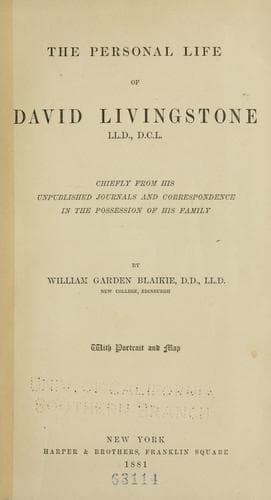
The Personal Life of David Livingstone: Chiefly from his Unpublished Journals and Correspondence in the Possession of His FamilyBlaikie, William Garden
Religion
The Personal Life of David Livingstone: Chiefly from his Unpublished Journals and Correspondence in the Possession of His Family
Blaikie, William Garden
Livingstone, David, 1813-1873
His chief work in Glasgow was the prosecution of medical study. Of his
teachers, two attracted him beyond the rest--the late Dr. Thomas Graham,
the very distinguished Professor of Chemistry, and Dr. Andrew Buchanan,
Professor of the Institutes of Medicine, his life-long and much-attached
friend. While attending Dr. Graham's class he was brought into frequent
contact with the assistant to the Professor, Mr. James Young. Originally
bred to a mechanical employment, this young man had attended the evening
course of Dr. Graham, and having attracted his attention, and done
various pieces of work for him, he became his assistant. The students
used to gather round him, and several met in his room, where there was a
bench, a turning-lathe, and other conveniences for mechanical work.
Livingstone took an interest in the turning-lathe, and increased his
knowledge of tools--a knowledge which proved of the highest service to
him when--as he used to say all missionaries should be ready to do--he
had to become a Jack-of-all-trades in Africa.
Livingstone was not the only man of mark who frequented that room, and
got lessons from Mr. Young "how to use his hands." The Right Hon. Lyon
Playfair, who has had so distinguished a scientific career, was another
of its habitués. A galvanic battery constructed by two young men on a
new principle, under Mr. Young's instructions, became an object of great
attraction, and among those who came to see it and its effects were two
sons of the Professor of Mathematics in the University. Although but
boys, both were fired at this interview with enthusiasm for electric
science. Both have been for many years Professors in the University of
Glasgow. The elder, Professor James Thomson, is well known for his
useful inventions and ingenious papers on many branches of science. The
younger, Sir William Thomson, ranks over the world as prince of
electricians, and second to no living man in scientific reputation.
Dr. Graham's assistant devoted himself to practical chemistry, and made
for himself a brilliant name by the purification of petroleum, adapting
it for use in private houses, and by the manufacture of paraffin and
paraffin-oil. Few men have made the art to which they devoted themselves
more subservient to the use of man than he whom Livingstone first knew
as Graham's assistant, and afterward used to call playfully "Sir
Paraffin." "I have been obliged to knight him," he used to say, "to
distinguish him from the other Young." The "other" Young was Mr. E. D.
Young, of the Search Expedition, and subsequently the very successful
leader of the Scotch Mission at Lake Nyassa. The assistant to Dr. Graham
still survives, and is well known as Mr. Young, of Kelly, LL.D.
and F.R.S.
Public-domain text, read in full here on John Shaqi.
Reviews
Reviews
No reviews yet
Be the first to share your thoughts on this work.
Join the Discussion
Join the discussion
Sign in to leave a comment or review.
Sign InorCreate an account