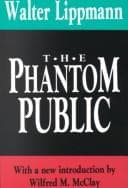
THE PHANTOM PUBLIC
BY
WALTER LIPPMANN
NEW YORK
HARCOURT, BRACE AND COMPANY
COPYRIGHT, 1925, BY
HARCOURT, BRACE AND COMPANY, INC.
Printed in the U. S. A.
TO
LEARNED HAND
“_The Voice of the People has been said to be the voice of God:
and however generally this maxim has been quoted and believed, it
is not true in fact._”—Alexander Hamilton, June 18, 1787, at the
Federal Convention (Yates’s notes, cited _Sources and Documents
Illustrating the American Revolution_, edited by S. G. Morison).
“... _consider ‘Government by Public Opinion’ as a formula.... It
is an admirable formula: but it presupposes, not only that public
opinion exists, but that on any particular question there is a
public opinion ready to decide the issue. Indeed, it presupposes
that the supreme statesman in democratic government is public
opinion. Many of the shortcomings of democratic government are
due to the fact that public opinion is not necessarily a great
statesman at all._”—From “Some Thoughts on Public Life,” a lecture
by Viscount Grey of Fallodon, February 3, 1923.
Contents
PART I
Chapter Page
I. The Disenchanted Man 13
II. The Unattainable Ideal 22
III. Agents and Bystanders 40
IV. What the Public Does 54
V. The Neutralization of Arbitrary Force 63
PART II
VI. The Question Aristotle Asked 77
VII. The Nature of a Problem 81
VIII. Social Contracts 95
IX. The Two Questions Before the Public 107
X. The Main Value of Public Debate 110
XI. The Defective Rule 115
XII. The Criteria of Reform 125
XIII. The Principles of Public Opinion 143
PART III
XIV. Society in Its Place 155
XV. Absentee Rulers 173
XVI. The Realms of Disorder 187
Index 201
PART I
Chapter I
THE DISENCHANTED MAN
1
Public-domain text, read in full here on John Shaqi.
Reviews
Reviews
No reviews yet
Be the first to share your thoughts on this work.
Join the Discussion
Join the discussion
Sign in to leave a comment or review.
Sign InorCreate an account