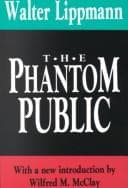
These conclusions are sharply at variance with the accepted theory of
popular government. That theory rests upon the belief that there is
a public which directs the course of events. I hold that this public
is a mere phantom. It is an abstraction. The public in respect to a
railroad strike may be the farmers whom the railroad serves; the public
in respect to an agricultural tariff may include the very railroad men
who were on strike. The public is not, as I see it, a fixed body of
individuals. It is merely those persons who are interested in an affair
and can affect it only by supporting or opposing the actors.
Since these random publics cannot be expected to deal with the merits
of a controversy, they can give their support with reasonable assurance
that it will do good only if there are easily recognizable and yet
pertinent signs which they can follow. Are there such signs? Can they
be discovered? Can they be formulated so they might be learned and
used? The chapters of this second part are an attempt to answer these
questions.
The signs must be of such a character that they can be recognized
without any substantial insight into the substance of a problem. Yet
they must be relevant to the solution of the problem. They must be
signs which will tell the members of a public where they can best align
themselves so as to promote the solution. In short, they must be guides
to reasonable action for the use of uninformed people.
The environment is complex. Man’s political capacity is simple. Can
a bridge be built between them? The question has haunted political
science ever since Aristotle first formulated it in the great seventh
book of his _Politics_. He answered it by saying that the community
must be kept simple and small enough to suit the faculties of its
citizens. We who live in the Great Society are unable to follow
his advice. The orthodox democrats answered Aristotle’s question by
assuming that a limitless political capacity resides in public opinion.
A century of experience compels us to deny this assumption. For us,
then, the old question is unanswered; we can neither reject the Great
Society as Aristotle did, nor exaggerate the political capacity of
the citizen as the democrats did. We are forced to ask whether it
is possible for men to find a way of acting effectively upon highly
complex affairs by very simple means.
Public-domain text, read in full here on John Shaqi.
Reviews
Reviews
No reviews yet
Be the first to share your thoughts on this work.
Join the Discussion
Join the discussion
Sign in to leave a comment or review.
Sign InorCreate an account