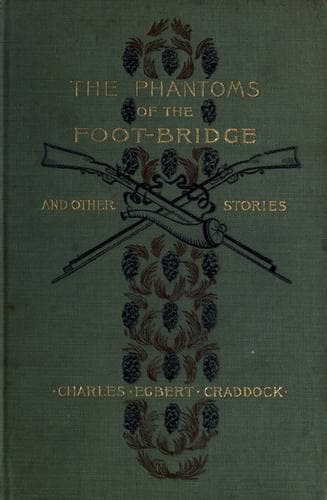
The Phantoms of the Foot-Bridge, and Other StoriesCraddock, Charles Egbert
General
The Phantoms of the Foot-Bridge, and Other Stories
Craddock, Charles Egbert
Cumberland Mountains -- Fiction; Mountain life -- Fiction; Tennessee -- Social life and customs -- Fiction
Purdee too was all a-quiver with eagerness. He had not beheld those
rocks since that terrible day when all the fine values of his gifted
vision had been withdrawn from him, and he could read no more with eyes
blinded by the limitations of what other men could see--the infinitely
petty purlieus of the average sense. He had a vague idea that should
they say this was his land where those strange rocks lay, he would see
again, he would read undreamed-of words, writ with a pen of fire. He
started toward them, and then with a conscious effort he held back.
The surveyor took no heed of the sentiments involved in processioning
Purdee's land. He stood leaning on his Jacob's-staff, as interesting to
him as Moses' rocks, and in his view infinitely more useful, and wiped
his brow, and looked about, and yawned. To him it was merely the
surveying for a foolish cause of a very impracticable and steep tract of
land, and the only reason it should be countenanced by heaven or earth
was the fees involved. And this was what he saw at the end of Purdee's
line.
Suddenly he took up his Jacob's-staff and marched on with a long stride,
bearing straight down upon the rocks. The whole _cortége_ started
anew--the genuflecting chain-bearers, the dodging, scrambling, running
spectators. On one of the strange stunted leafless trees a colony of
vagrant crows had perched, eerie enough to seem the denizens of those
weird forests; they broke into raucous laughter--Haw! haw! haw!--rising
to a wild commotion of harsh, derisive discord as the men once more gave
vent to loud, excited cries. For the surveyor, stalking ahead, had
passed beyond the great tables of the Law; the chain-bearers were
drawing Purdee's line on the other side of them, and they had fallen, if
ever they fell here from Moses' hand and broke in twain, upon Purdee's
land, granted to his ancestor by the State of Tennessee.
He could not speak for joy, for pride. His dark eyes were illumined by a
glancing, amber light. He took off his hat and smoothed with his rough
hand his long black hair, falling from his massive forehead. He leaned
against one of the stunted oaks, shouldering his rifle that he had
loaded for Grinnell--he could hardly believe this, although he
remembered it. He did not want to shoot Grinnell; he would not waste the
good lead!
And indeed Grinnell had much ado to defend himself against the sneers
and rebukes with which the party beguiled the way through the wintry
woods. "Ter go a-claimin' another man's land, an' put him ter the
expense o' processionin' it, an' git his line run!" exclaimed the
blacksmith, indignantly. "An' ye 'ain't got nare sign o' a show at
Moses' tables!"
"I dunno how this hyar line air a-runnin'," declared Grinnell, sorely
beset. "I don't b'lieve it air a-runnin' north."
The surveyor was hard by. He had planted his staff again, and was once
more taking his bearings. He looked up for a second.
"North_west_," he said.
Public-domain text, read in full here on John Shaqi.
Reviews
Reviews
No reviews yet
Be the first to share your thoughts on this work.
Elsewhere in the archive
Join the Discussion
Join the discussion
Sign in to leave a comment or review.
Sign InorCreate an account