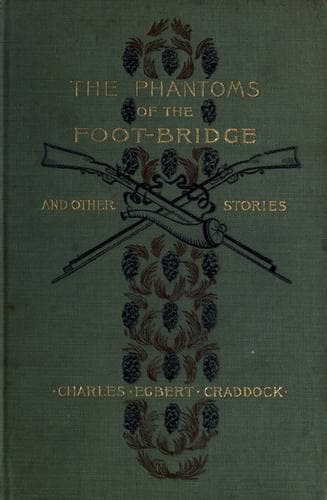
The Phantoms of the Foot-Bridge, and Other StoriesCraddock, Charles Egbert
General
The Phantoms of the Foot-Bridge, and Other Stories
Craddock, Charles Egbert
Cumberland Mountains -- Fiction; Mountain life -- Fiction; Tennessee -- Social life and customs -- Fiction
Grinnell stared for a moment; then strode up to the surveyor, and
pointed with his stubby finger at a word on his deed.
The official looked with interest at it; he held up suddenly Purdee's
grant and read aloud, "From Crystal Spring seven hundred poles
north_west_ to a stake in the middle of the river."
He examined, too, the original plat of survey which he had taken to
guide him, and also the plat made when Squire Bates sold to Grinnell's
father; "north_west_" they all agreed. There was evidently a clerical
error on the part of the scrivener who had written Grinnell's deed.
In a moment the harassed man saw that through the processioning of
Purdee's land he had lost heavily in the extent of his supposed
possessions. He it was who had claimed what was rightfully another's.
And because of the charge Purdee was the richer by a huge slice of
mountain land--how large he could not say, as he ruefully followed the
line of survey.
But for this discovery the interest of processioning Purdee's land would
have subsided with the determination of the ownership of the limited
environment of the stone tables of the Law. Now, as they followed the
ever-diverging line to the northwest, the group was pervaded by a
subdued and tremulous excitement, in which even the surveyor shared. Two
or three whispered apart now and then, and Grinnell, struggling to
suppress his dismay, was keenly conscious of the glances that sought him
again and again in the effort to judge how he was taking it. Only Purdee
himself was withdrawn from the interest that swayed them all. He had
loitered at first, dallying with a temptation to slip silently from the
party and retrace his way to the tables and ascertain, perchance, if
some vestige of that mystic scripture might not reveal itself to him
anew, or if it had been only some morbid fancy, some futile influence of
solitude, some fevered condition of the blood or the brain, that had
traced on the stone those gracious words, the mere echo of which--his
stuttered, vague recollections--had roused the camp-meeting to fervid
enthusiasms undreamed of before. And then he put from him the
project--some other time, perhaps, for doubts lurked in his heart,
hesitation chilled his resolve--some other time, when his companions and
their prosaic influence were all far away. He was roused abruptly, as he
stalked along, to the perception of the deepening excitement among them.
They had emerged from the dense growths of the mountain to the lower
slope, where pastures and fields--whence the grain had been
harvested--and a garden and a dwelling, with barns and fences, lay
before them all. And as Purdee stopped and stared, the realization of a
certain significant fact struck him so suddenly that it seemed to take
his breath away. That divergent line stretching to the northwest had
left within his boundaries the land on which his enemy had built his
home.
He looked; then he smote his thigh and laughed aloud.
Public-domain text, read in full here on John Shaqi.
Reviews
Reviews
No reviews yet
Be the first to share your thoughts on this work.
Elsewhere in the archive
Join the Discussion
Join the discussion
Sign in to leave a comment or review.
Sign InorCreate an account