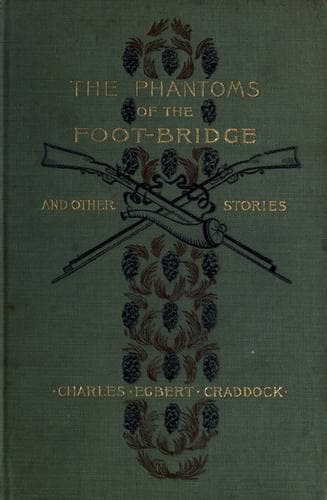
The Phantoms of the Foot-Bridge, and Other StoriesCraddock, Charles Egbert
General
The Phantoms of the Foot-Bridge, and Other Stories
Craddock, Charles Egbert
Cumberland Mountains -- Fiction; Mountain life -- Fiction; Tennessee -- Social life and customs -- Fiction
The rocks on the river-bank caught the sound, and echoed it again and
again, till the air seemed full of derisive voices. Under their stings
of jeering clamor, and under the anguish of the calamity which his
reeling senses could scarcely measure, Job Grinnell's composure suddenly
gave way. He threw up his arms and called upon Heaven; he turned and
glared furiously at his enemy. Then, as Purdee's laughter still jarred
the air, he drew a "shooting-iron" from his pocket. The blacksmith
closed with him, struggling to disarm him. The weapon was discharged in
the turmoil, the ball glancing away in the first quiver of sunshine
that had reached the earth to-day, and falling spent across the river.
Grinnell wrested himself from the restraining grasp, and rushed down the
slope to his gate to hide himself from the gaze of the world--his world,
that little group. Then remembering that it was no longer his gate, he
turned from it in an agony of loathing. And knowing that earth held no
shelter for him but the sufferance of another man's roof, he plunged
into the leafless woods as if he heavily dragged himself by a power
which warred within him with other strong motives, and disappeared among
the myriads of holly bushes all aglow with their red berries.
The spectators still followed the surveyor and his Jacob's-staff, but
Purdee lingered. He walked around the fence with a fierce, gloating eye,
a panther-like, loping tread, as a beast might patrol a fold before he
plunders it. All the venom of the old feud had risen to the opportunity.
Here was his enemy at his mercy. He knew that it was less than seven
years since the enclosures had been made, acres and acres of tillable
land cleared, the houses built--all achieved which converted the
worthlessness of a wilderness into the sterling values of a farm.
He--he, Roger Purdee--was a rich man for the "mountings," joining his
little to this competence. All the cruelties, all the insults, all the
traditions of the old vendetta came thronging into his mind, as
distinctly presented as if they were a series of hideous pictures; for
he was not used to think in detail, but in the full portrayal of
scenes. The Purdee wrongs were all avenged. This result was so
complete, so baffling, so ruinous temporally, so humiliating
spiritually! It was the fullest replication of revenge for all that had
challenged it.
"How Uncle Ezra would hev rej'iced ter hev lived ter see this day!" he
thought, with a pious regret that the dead might not know.
Public-domain text, read in full here on John Shaqi.
Reviews
Reviews
No reviews yet
Be the first to share your thoughts on this work.
Elsewhere in the archive
Join the Discussion
Join the discussion
Sign in to leave a comment or review.
Sign InorCreate an account