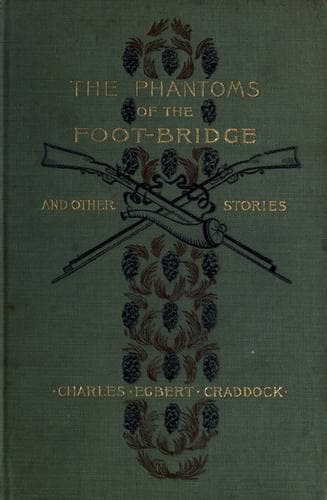
The Phantoms of the Foot-Bridge, and Other StoriesCraddock, Charles Egbert
General
The Phantoms of the Foot-Bridge, and Other Stories
Craddock, Charles Egbert
Cumberland Mountains -- Fiction; Mountain life -- Fiction; Tennessee -- Social life and customs -- Fiction
Simeon Roxby had a keen, not unkindly face, and he had that look of
extreme intelligence which is entirely distinct from intellectuality,
and which one sometimes sees in a minor degree in a very clever dog or a
fine horse. One might rely on him to understand instinctively everything
one might say to him, even in its subtler æsthetic values, although he
had consciously learned little. He was of the endowed natures to whom
much is given, rather than of those who are set to acquire. He had many
lines in his face--even his simple life had gone hard with him, its
sorrows unassuaged by its simplicity. His hair was grizzled, and hung
long and straight on his collar. He wore a grizzled beard cut broad and
short. His boots had big spurs, although the lank old sorrel had never
felt them. He sat his horse like the cavalryman he had been for four
years of hard riding and raiding, but his face had a certain gentleness
that accented the Quaker-like suggestion of his garb, a look of
communing with the higher things.
"I never blamed 'em," he went on, evidently reverting to the spectres of
the bridge--"I never blamed 'em for comin' back wunst in a while. It
'pears ter me 'twould take me a long time ter git familiar with heaven,
an' sociable with them ez hev gone before. An', my Lord, jes' think what
the good green yearth is! Leastwise the mountings. I ain't settin' store
on the valley lands I seen whenst I went ter the wars. I kin remember
yit what them streets in the valley towns smelt like."
He lifted his head, drawing a long breath to inhale the exquisite
fragrance of the fir, the freshness of the pellucid water, the aroma of
the autumn wind, blowing through the sere leaves still clinging red and
yellow to the boughs of the forest.
"Naw, I ain't blamin' 'em, though I don't hanker ter view 'em," he
resumed. "One of 'em I wouldn't be afeard of, though. I feel mighty
sorry fur her. The old folks used ter tell about her. A young 'oman she
war, a-crossin' this bredge with her child in her arms. She war young,
an' mus' have been keerless, I reckon; though ez 'twar her fust baby,
she moughtn't hev been practised in holdin' it an' sech, an' somehows it
slipped through her arms an' fell inter the ruver, an' war killed in a
minit, dashin' agin the rocks. She jes' stood fur a second a-screamin'
like a wild painter, an' jumped off'n the bredge arter it. She got it
agin; for when they dragged her body out'n the ruver she hed it in her
arms too tight fur even death ter onloose. An' thar they air together in
the buryin'-ground."
He gave a nod toward the slope of the mountain that intercepted the
melancholy view of the graveyard.
Public-domain text, read in full here on John Shaqi.
Reviews
Reviews
No reviews yet
Be the first to share your thoughts on this work.
Join the Discussion
Join the discussion
Sign in to leave a comment or review.
Sign InorCreate an account