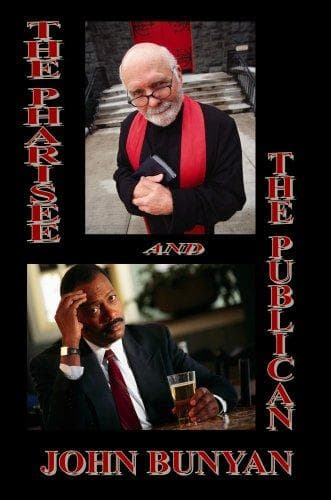
Pharisee and the publican (Parable) -- Early works to 1800
The Publican’s shame, therefore, which he demonstrated by hanging down
his head, was godly and holy, and much like that of the prodigal, when he
said, “Father, I have sinned against heaven, and in thy sight, and am no
more worthy to be called thy son;” Luke xv. 21. I suppose that his
postures were much the same with the Publican’s, as were his prayers, for
the substance of them. O however grace did work in both to the same end!
they were both of them, after a godly manner, ashamed of their sins.
“He would not lift up so much as his eyes to heaven.”
He could not, he would not: which yet more fully makes it appear, that it
was shame, not guilt only, or chiefly, though it is manifest enough that
he had guilt; by his crying, “God be merciful to me a sinner.” I say,
guilt was not the chief cause of hanging down his head, because it saith,
he _would_ not; for when guilt is the cause of stooping, it lieth not in
the will, or in the power thereof, to help one up.
David tells us, that when he was under guilt, his iniquities were gone
over his head: as an heavy burden, they were too heavy for him; and that
with them he was bowed down greatly. Or, as he says in another place,
“Mine iniquities have taken hold upon me, so that I am not able to look
up;” Psalm xxxviii.; xl. I am not able to do it: guilt disableth the
understanding, and conscience; shame makes all willingly fall at the feet
of Christ.
He would not. He knew what he was, what he had been, and should be, if
God had not mercy upon him; yea, he knew also that God knew what he was,
had been, and would be, if mercy prevented not; wherefore, thought he,
Wherefore should I lift up the head? I am no righteous man, no godly
man, I have not served God, but Satan; this I know, this God knows, this
angels know, wherefore I will not lift up the head. It is as much as to
say, I will not be an hypocrite, like the Pharisee: for lifting up of the
head signifies innocency and harmlessness of life, or good conscience,
and the testimony thereof, under and in the midst of all accusations.
Wherefore this was the counsel of Zophar to Job—“If,” saith he, “thou
prepare thine heart, and stretch out thine hand towards him; if iniquity
be in thine hand, put it far away, and let not wickedness dwell in thy
tabernacles. For then shalt thou lift up thy face without spot; yea,
thou shalt be steadfast, and shalt not fear;” Job xi. 13–15.
Public-domain text, read in full here on John Shaqi.
Reviews
Reviews
No reviews yet
Be the first to share your thoughts on this work.
Elsewhere in the archive
Join the Discussion
Join the discussion
Sign in to leave a comment or review.
Sign InorCreate an account