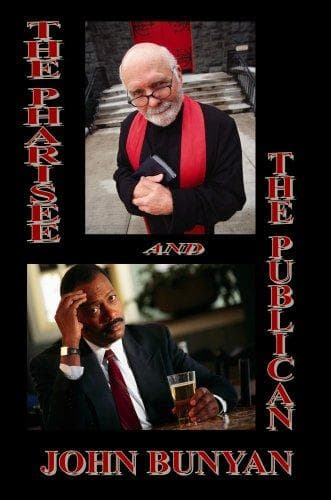
Pharisee and the publican (Parable) -- Early works to 1800
This was not the Publican’s state: he had lived in lewdness and villany
all his days; nor had he prepared his heart to seek the Lord God of his
fathers; he had not cleansed his heart nor hands from violence, nor done
that which was lawful and right. He only had been convinced of his evil
ways, and was come into the temple as he was, all foul, and in his filthy
garments, and amidst his pollutions; how then could he be innocent, holy,
or without spot? and, consequently, how could he lift up his face to God?
I remember what Abner said to Asahel, “Turn thee aside (said he) from
following me, wherefore should I smite thee to the ground? how then
should I hold up my face to Joab, thy brother?” 2 Sam. ii. 22.
As if he had said, If I kill thee, I shall blush, be ashamed, and hang my
head like a bulrush the next time I come into the company of thy brother.
This was the Publican’s case: he was guilty, he had sinned, he had
committed a trespass; and now being come into the temple, into the
presence of that God whose laws he had broken, and against whom he had
sinned, how could he lift up his head? how could he do it? No, it better
became him to take his shame, and to hang his head in token of guilt; and
indeed he did, and did it to purpose too, for he would not lift up, no
not so much as his eyes to heaven.
True, some would have done it; the Pharisee did it; though if he had
considered that hypocrisy and the leaning to his own righteousness had
been a sin, he would have found as little cause to have done it as did
the Publican himself. But, I say he did it, and sped therein; he went
down to his house, as he came up into the temple, a poor unjustified
Pharisee, whose person and prayer were both rejected; because, like the
whore of whom we read in the Proverbs, after he had practised all manner
of hypocrisy, he comes into the temple and wipes his mouth, and saith, “I
have done no wickedness;” Prov. xxx. 20. He lifts up his head, his face,
his eyes, to heaven; he struts, he vaunts himself; he swaggers, he
vapours, and cries up himself, saying, “God I thank thee that I am not as
other men are.”
True, had he come and stood before a stock or stone, he might have said
thus, and not have been reprehended; for such are gods that see not, nor
hear, neither do they understand. But to come before the true God, the
living God, the God that fills heaven and earth by his presence, and that
knows the things that come into the mind of man, even every one of them;
I say, to come into his house, to stand before him, and thus to lift up
his head and eyes in such hypocrisy before him, this was abominable, this
was to tempt God, and to prove him, yea, to challenge him to know what
was in man, if he could, even as those who said, “How doth God (see)
know? can he judge through the dark cloud?” Job xxii. 13; Psalm lxxiii.
11.
Public-domain text, read in full here on John Shaqi.
Reviews
Reviews
No reviews yet
Be the first to share your thoughts on this work.
Elsewhere in the archive
Join the Discussion
Join the discussion
Sign in to leave a comment or review.
Sign InorCreate an account