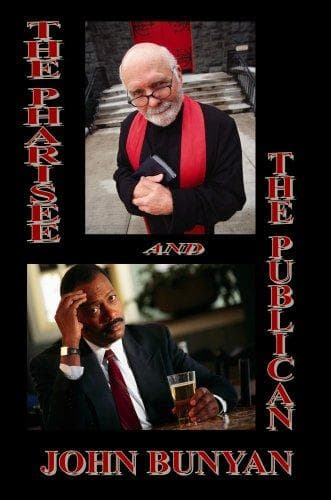
Pharisee and the publican (Parable) -- Early works to 1800
And hence it is that you find such people so fickle and uncertain in
their spirits; now on the mount, then in the valleys; now in the
sunshine, then in the shade: now warm, then frozen; now bonny and blithe,
then in a moment pensive and sad, as thinking of a portion nowhere but in
hell. This will cause smiting on the breast; nor can I imagine that the
Publican was as yet farther than thus far in the Christian’s progress.
6. Smiting upon the breast seems to intimate, that the party so doing is
very apprehensive of some great loss that he has sustained, either by
negligence, carelessness, foolishness, or the like. And this is the way
in which men do lose their souls. Now, to lose a thing, a great thing,
the only choice thing that a man has, negligently, carelessly, foolishly,
or the like, why, it puts aggravations into the thoughts of the loss that
the man has sustained, and aggravations into the thoughts of them go out
of the soul, and come in upon a sudden, even as the bailiff or the king’s
serjeant-at-arms, and at every appearance of them, makes the soul start;
and starting, it smites upon the breast.
I might multiply particulars; but to be brief, we have before us a
sensible soul, a sorrowful soul, a penitent soul; one that prays indeed,
that prays sensibly, affectionately, effectually; one that sees his loss,
that fears and trembles before God in consideration of it, and one that
knows no way but the right way, to secure himself from perishing, to wit,
by having humble and hearty recourse to the God of heaven for mercy.
I should now come to speak something by way of use and application: but
before I do that, I will briefly draw up, and present you with a few
conclusions that in my judgment do naturally flow from the text;
therefore in this place I will read over the text again.
“Two men went up into the temple to pray; the one a Pharisee, the other a
Publican. The Pharisee stood and prayed thus with himself, God, I thank
thee, that I am not as other men are, extortioners, unjust, adulterers,
or even as this Publican. I fast twice in the week, I give tithes of all
that I possess. And the Publican standing afar off would not lift up so
much as his eyes unto heaven, but smote upon his breast, saying, God be
merciful to me a sinner.”
From these words I gather these several conclusions, with these
inferences.
1. It doth not always follow, that they that pray do know God, or love
him, or trust in him. This conclusion is evident by the Pharisee in the
text; he prayed, but he knew not God, he loved not God, he trusted not in
God; that is, he knew him not in his Son, nor loved, nor trusted in him.
He was, though a praying man, far off from this.
Public-domain text, read in full here on John Shaqi.
Reviews
Reviews
No reviews yet
Be the first to share your thoughts on this work.
Elsewhere in the archive
Join the Discussion
Join the discussion
Sign in to leave a comment or review.
Sign InorCreate an account