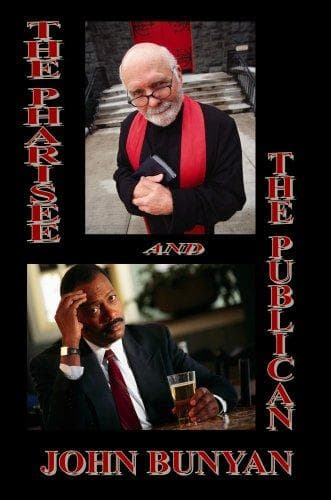
Pharisee and the publican (Parable) -- Early works to 1800
Whence it may be inferred, that those that pray not at all cannot be
good, cannot know, love, or trust in God. For if the star, though it
shine, is not the sun, then surely a clod of dirt cannot be the sun.
Why, a praying man doth as far outstrip a non-praying man as a star
outstrips a clod of earth. A non-praying man lives like a beast. “The
ox knows his owner, and the ass his master’s crib; but this man doth not
know, but this man doth not consider;” Isa. i. 3. The prayerless man is
therefore of no religion, except he be an Atheist, or an Epicurean.
Therefore the non-praying man is numbered among the heathens, and among
those that know not God, and is appointed and designed by the sentence of
the word to the fearful wrath of God; Psal. lxxix. 6; Jer. x. 25.
2. A second conclusion is, That the man that prays, if in his prayer he
pleads for acceptance, either in whole or in part, for his own good
deeds, is in a miserable state. This also is gathered from the Pharisee
here; he prayed, but in this prayer he pleaded his own good deeds for
acceptance, that is, of his person, and therefore went down to his house
unjustified. And he is in this condition that doth thus. The conclusion
is true, forasmuch as the Pharisee mentioned in the parable is not so
spoken of for the sake of that sect of men, but to caution, forewarn, and
bid all men take heed, that they by doing as he, procure not their
rejection of God, and be sent away from his presence unjustified. I do
therefore infer from hence, that if he that pleadeth his own good doing
for personal acceptance with God be thus miserable, then he that teacheth
men so to do is much more miserable.
We always conclude, that a ring-leader in an evil way is more
blame-worthy than those that are led of him. This falls hard upon the
leading Socinians and others, who teach that men’s works make their
persons accepted of God.
True, they say, through Christ; but that is brought in merely to delude
the simple with, and is an horrible lie; for we read not in all the word
of God as to personal justification in the sight of God from the curse
(and that is the question under consideration), that it must be by man’s
righteousness as made prevalent by Christ’s, but contrariwise, by his and
his only, without the deeds, works, or righteousness of the law, which is
our righteousness. Wherefore, I say, the teachers and leaders of this
doctrine have the greater sin.
3. A third conclusion is, They that use high and flaunting language in
prayer, their simplicity and godly sincerity is to be questioned as to
the doing of that duty sincerely. This still flows from our text; the
Pharisee greatly used this: for higher and more flaunting language can
hardly be found than in the Pharisee’s mouth; nor will ascribing to God
by the same mouth laud and praise help the business at all: for to be
sure, where the effect is base and rotten, the cause cannot be good.
Public-domain text, read in full here on John Shaqi.
Reviews
Reviews
No reviews yet
Be the first to share your thoughts on this work.
Elsewhere in the archive
Join the Discussion
Join the discussion
Sign in to leave a comment or review.
Sign InorCreate an account