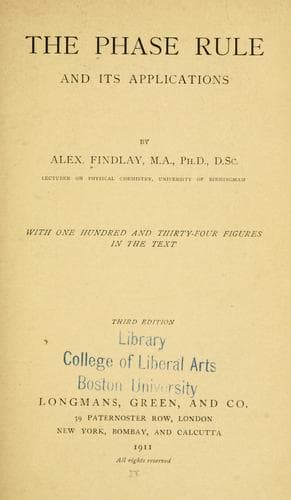
The Phase Rule and Its ApplicationsFindlay, Alexander
Science
The Phase Rule and Its Applications
Findlay, Alexander
Chemistry, Physical and theoretical; Phase rule and equilibrium; Solution (Chemistry)
Before that time, certainly, attempts had been made to bring the different
known cases of equilibria--chemical and physical--under general laws. From
the very first, both Wenzel[6] and Berthollet[7] recognized the influence
exercised by the _mass_ of the substances on the equilibrium of the system.
It was reserved, however, for Guldberg and Waage, by their more general
statement and mathematical treatment of the Law of Mass Action,[8] to
inaugurate the period of quantitative study of equilibria. The law which
these investigators enunciated {8} served satisfactorily to summarize the
conditions of equilibrium in many cases both of homogeneous and, with the
help of certain assumptions and additions, of heterogeneous equilibrium. By
reason, however, of the fact that it was developed on the basis of the
kinetic and molecular theories, and involved, therefore, certain
hypothetical assumptions as to the nature and condition of the substances
taking part in the equilibrium, the law of mass action failed, as it
necessarily must, when applied to those systems in which neither the number
of different molecular aggregates nor the degree of their molecular
complexity was known.
Ten years after the law of mass action was propounded by Guldberg and
Waage, Willard Gibbs,[9] Professor of Physics in Yale University, showed
how, in a perfectly general manner, free from all hypothetical assumptions
as to the molecular condition of the participating substances, all cases of
equilibrium could be surveyed and grouped into classes, and how
similarities in the behaviour of apparently different kinds of systems, and
differences in apparently similar systems, could be explained.
As the basis of his theory of equilibria, Gibbs adopted the laws of
thermodynamics,[10] a method of treatment which had first been employed by
Horstmann.[11] In deducing the law of equilibrium, Gibbs regarded a system
as possessing only three independently variable factors[12]--temperature,
pressure, and the concentration of the components of the system--and he
enunciated the general theorem now usually known as the _Phase Rule_, by
which he defined the conditions of equilibrium as a relationship between
the number of what are called the phases and the components of the system.
Public-domain text, read in full here on John Shaqi.
Reviews
Reviews
No reviews yet
Be the first to share your thoughts on this work.
Join the Discussion
Join the discussion
Sign in to leave a comment or review.
Sign InorCreate an account