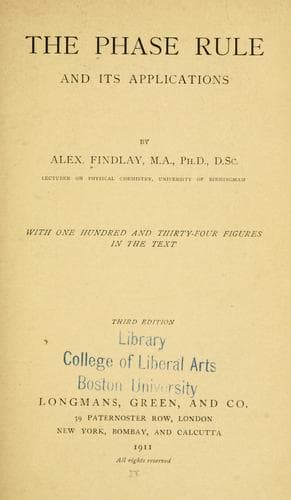
The Phase Rule and Its ApplicationsFindlay, Alexander
Science
The Phase Rule and Its Applications
Findlay, Alexander
Chemistry, Physical and theoretical; Phase rule and equilibrium; Solution (Chemistry)
In order to determine the position of the natural melting point, it was
necessary, on account of the slowness of transformation, to employ a
catalytic agent in order to increase the velocity with which the
equilibrium was established. A drop of concentrated sulphuric acid served
the purpose. In presence of a trace of this substance, isomeric
transformation very speedily occurs, and leads to the condition of
equilibrium. Starting in the one case with fused paraldehyde, and in the
other case with acetaldehyde, the same freezing point, viz. 6.75°, was
obtained, the solid phase being paraldehyde. This temperature, 6.75°, is
therefore the natural freezing point, and paraldehyde, the solid in
equilibrium with the liquid phase at this point, is the stable form.
With regard to the change of equilibrium with the temperature, it was found
that whereas the liquid phase contained 11.7 molecules per cent. of
acetaldehyde at the natural freezing point, the liquid at the temperature
of 41.6° contains 46.6 molecules per cent. of acetaldehyde. As the
temperature {206} rises, therefore, there is increased formation of
acetaldehyde, or a decreasing amount of polymerisation. This is in harmony
with the fact that the polymerisation of acetaldehyde is accompanied by
evolution of heat.
While speaking of these isomerides, it may be mentioned that at the
temperature 41.6° the equilibrium mixture has a vapour pressure equal to
the atmospheric pressure. At this temperature, therefore, the equilibrium
mixture (obtained quickly with the help of a trace of sulphuric acid)
boils.[289]
* * * * *
{207}
CHAPTER XII
SUMMARY.--APPLICATION OF THE PHASE RULE TO THE STUDY OF SYSTEMS OF TWO
COMPONENTS
In this concluding chapter on two-component systems, it is proposed to
indicate briefly how the Phase Rule has been applied to the elucidation of
a number of problems connected with the equilibria between two components,
and how it has been employed for the interpretation of the data obtained by
experiment. It is hoped that the practical value of the Phase Rule may
thereby become more apparent, and its application to other cases be
rendered easier.
Public-domain text, read in full here on John Shaqi.
Reviews
Reviews
No reviews yet
Be the first to share your thoughts on this work.
Elsewhere in the archive
Join the Discussion
Join the discussion
Sign in to leave a comment or review.
Sign InorCreate an account