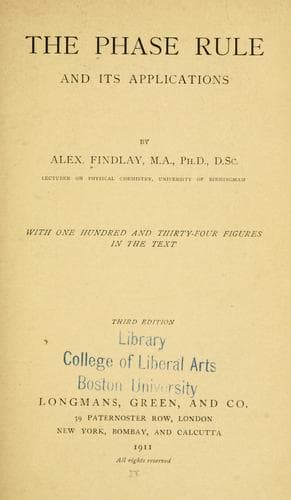
The Phase Rule and Its ApplicationsFindlay, Alexander
Science
The Phase Rule and Its Applications
Findlay, Alexander
Chemistry, Physical and theoretical; Phase rule and equilibrium; Solution (Chemistry)
The study of the formation of minerals from the point of view of the Phase
Rule is still in its initial stages, but the results which have already
been obtained give promise of a rich harvest in the future.[316]
* * * * *
{234}
CHAPTER XIII
SYSTEMS OF THREE COMPONENTS
General.--It has already been made evident that an increase in the number
of the components from one to two gives rise to a considerable increase in
the possible number of systems, and introduces not a few complications into
the equilibrium relations of these. No less is this the case when the
number of components increases from two to three; and although examples of
all the possible types of systems of three components have not been
investigated, nor, indeed, any one type fully, nevertheless, among the
systems which have been studied experimentally, cases occur which not only
possess a high scientific interest, but are also of great industrial
importance. On account not only of the number, but more especially of the
complexity of the systems constituted of three components, no attempt will
be made to give a full account, or, indeed, even a survey of all the cases
which have been subjected to a more or less complete experimental
investigation; on the contrary, only a few of the more important classes
will be selected, and the most important points in connection with the
behaviour of these described.
On applying the Phase Rule
P + F = C + 2
to the systems of three components, we see that in order that the system
shall be invariant, no fewer than five phases must be present together, and
an invariant system will therefore exist at a _quintuple_ point. Since the
number of liquid phases can never exceed the number of the components, and
since there can be only one vapour phase, it is evident that in this case,
{235} as in others, there must always be at least one solid phase present
at the quintuple point. As the number of phases diminishes, the variability
of the system can increase from one to four, so that in the last case the
condition of the system will not be completely defined until not only the
temperature and the total pressure of the system, but also the
concentrations of two of the components have been fixed. Or, instead of the
concentrations, the partial pressures of the components may also be taken
as independent variables.
Public-domain text, read in full here on John Shaqi.
Reviews
Reviews
No reviews yet
Be the first to share your thoughts on this work.
Elsewhere in the archive
Join the Discussion
Join the discussion
Sign in to leave a comment or review.
Sign InorCreate an account