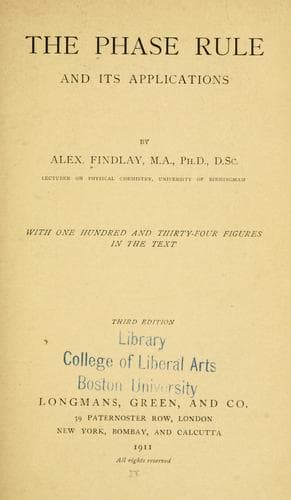
The Phase Rule and Its ApplicationsFindlay, Alexander
Science
The Phase Rule and Its Applications
Findlay, Alexander
Chemistry, Physical and theoretical; Phase rule and equilibrium; Solution (Chemistry)
[86] _Phil. Mag._, 1884 [5], 18. 210. See also Roozeboom, _Das Heterogene
Gleichgewicht_, I. p. 177.
[87] Brauns, _Neues Jahrbuch für Mineralogie_, 1900, 13. Beilage-Band, p.
39; Roozeboom, _Das Heterogene Gleichgewicht_, I. p. 181.
[88] _Monatshefte_, 1888, 9. 435.
[89] Gattermann, _Ber._, 1890, 53. 1738.
[90] _Zeitschr. physikal. Chem._, 1889, 4. 468; _Annalen der Physik_, 1900
[4], 2. 649.
[91] Quincke, _Annalen der Physik_, 1894 [3], 53. 613; Tammann, _Annalen
der Physik_, 1901 [4], 4. 524; 1902, 8. 103; Rotarski, _ibid._, 4. 528.
[92] _Annalen der Physik_, 1900 [4], 2. 649.
[93] _Annalen der Physik_, 1902 [4], 8. 911.
[94] See, more especially, O. Lehmann, _Annalen der Physik_, 1900 [4], 2.
649; Reinitzer, _Sitzungsber. kaiserl. Akad. zu Wien._, 1888, 94. (2), 719;
97. (1), 167; Gattermann, _loc. cit._; Schenck, _Zeitschr. physikal.
Chem._, 1897, 23. 703; 1898, 25. 337; 27. 170; 1899, 28. 280; Schenck and
Schneider, _ibid._, 1899, 29. 546; Abegg and Seitz, _ibid._, 1899, 29. 491;
Hulett, _ibid._, 1899, 28. 629; Coehn, _Zeitschr. Elektrochem._, 1904, 10.
856: Bredig and Schukowsky, _ibid._, 3419. For a full account of the
subject, the reader is referred to the work by Lehmann, _Flüssige
Kristalle_ (Engelmann, 1904), or the smaller monograph by Schenck,
_Kristallinische Flüssigkeiten und flüssige Kristalle_ (Engelmann, 1905).
[95] A. C. de Kock, _Zeitschr. physikal. Chem._, 1904, 48. 129.
[96] On account of the fact that all grades of rigidity have been realized
between the ordinary solid and the liquid state, in the case both of
crystalline and amorphous substances, it has been proposed to abandon the
terms "solid" and "liquid," and to class bodies as "crystalline" or
"amorphous," the passage from the one condition to the other being
discontinuous; crystalline bodies possess a certain regular orientation of
their molecules and a directive force, while in amorphous bodies these are
wanting (see Lehmann, _Annalen der Physik_, 1900 [4], 2. 696).
[97] Hulett, _loc. cit._
[98] Roozeboom, _Das Heterogene Gleichgewicht_, I. p. 144. See also
Schenck, _Kristallinische Flüssigkeiten und flüssige Kristalle_, p. 8
(Engelmann, 1904).
[99] The possible number of triple points in a one-component system is
given by the expression (_n_(_n_ - 1)(_n_ - 2))/1.2.3, where _n_ is the
number of phases (Riecke, _Zeitschr. physikal. Chem._, 1890, 6, 411). The
number of triple points, therefore, increases very rapidly as the number of
possible phases increases.
[100] Duhem, _Zeitschr. physikal. Chem._, 1891, 8. 371. _Cf._ Roozeboom,
_Das Heterogene Gleichgewicht_, p. 94 ff.
[101] Roozeboom, _Das Heterogene Gleichgewicht_, I. p. 99.
[102] Roozeboom, _Zeitschr. physikal. Chem._, 1888, 2. 474.
Public-domain text, read in full here on John Shaqi.
Reviews
Reviews
No reviews yet
Be the first to share your thoughts on this work.
Elsewhere in the archive