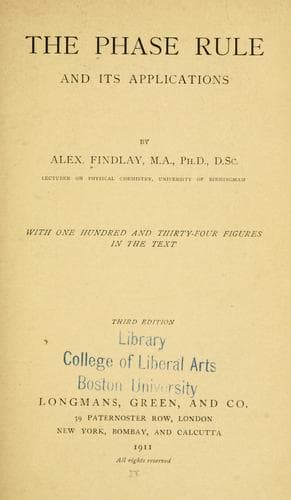
The Phase Rule and Its ApplicationsFindlay, Alexander
Science
The Phase Rule and Its Applications
Findlay, Alexander
Chemistry, Physical and theoretical; Phase rule and equilibrium; Solution (Chemistry)
SOLID SOLUTIONS. MIXED CRYSTALS 175
General, 175. Solution of gases in solids, 176. Palladium
and hydrogen, 178. Solutions of solids in solids. Mixed
crystals, 180. Formation of mixed crystals of isomorphous
substances, 182. I. The two components can form an unbroken
series of mixed crystals. (_a_) _The freezing points of all mixtures
lie between the freezing points of the pure components._ Examples,
183. Melting-point curve, 183. (_b_) _The freezing-point curve passes
through a maximum._ Example, 186. (_c_) _The freezing-point
curve passes through a minimum._ Example, 188. Fractional
{xiv}
crystallization of mixed crystals, 188. II. The two components
do not form a continuous series of mixed crystals. (_a_) _The
freezing-point curve exhibits a transition point_, 190. Example,
190. (_b_) _The freezing-point curve exhibits a eutectic point_, 191.
Examples, 192. Changes in mixed crystals with the temperature,
192.
CHAPTER XI
EQUILIBRIUM BETWEEN DYNAMIC ISOMERIDES 195
Temperature-concentration diagram, 196. Transformation
of the unstable into the stable form, 201. Examples, 203.
_Benzaldoximes_, 203. _Acetaldehyde and paraldehyde_, 204.
CHAPTER XII
SUMMARY.--APPLICATION OF THE PHASE RULE TO THE STUDY OF SYSTEMS OF
TWO COMPONENTS 207
Summary of the different systems of two components, 208.
(1) _Organic compounds_, 212. (2) _Optically active substances_,
213. Examples, 216. Transformations, 217. (3) _Alloys_, 220.
Iron--carbon alloys, 223. Determination of the composition of
compounds without analysis, 228. Formation of minerals, 232.
CHAPTER XIII
SYSTEMS OF THREE COMPONENTS 234
General, 234. Graphic representation, 235.
CHAPTER XIV
SOLUTIONS OF LIQUIDS IN LIQUIDS 240
1. _The three components form only one pair of partially
miscible liquids_, 240. Retrograde solubility, 245. The influence
of temperature, 247. 2. _The three components can form two
pairs of partially miscible liquids_, 249. 3. _The three components
form three pairs of partially miscible liquids_, 251.
CHAPTER XV
PRESENCE OF SOLID PHASES 253
A. The ternary eutectic point, 253. Formation of compounds,
255. B. Equilibria at higher temperatures. Formation
of double salts, 258. Transition point, 258. Vapour pressure.
{xv}
Quintuple point, 261. Solubility curves at the transition point,
264. Decomposition of the double salt by water, 267. Transition
interval, 270. Summary, 271.
CHAPTER XVI
ISOTHERMAL CURVES AND THE SPACE MODEL 272
Public-domain text, read in full here on John Shaqi.
Reviews
Reviews
No reviews yet
Be the first to share your thoughts on this work.
Join the Discussion
Join the discussion
Sign in to leave a comment or review.
Sign InorCreate an account