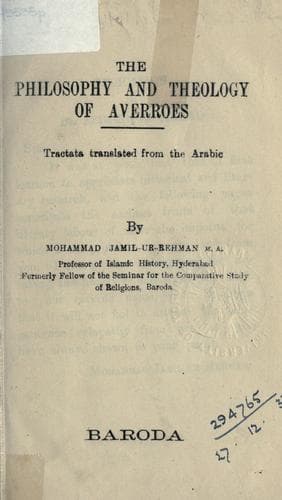
MOHAMMAD JAMIL UR REHMAN
_Osmania University,
Hyderabad._
CONTENTS
I. A Decisive Discourse on the Delineation of the Relation between
Religion and Philosophy.
I a. Appendix: On the Problem of Eternal Knowledge which Averroes has
mentioned in his Decisive Discourse.
II. An Exposition of the Methods of Argument concerning the Doctrines
of the Faith, and a Determination of Doubts and misleading Innovation
brought into the Faith through Interpretations.
I
A DECISIVE DISCOURSE ON THE DELINEATION
OF THE
RELATION BETWEEN RELIGION AND PHILOSOPHY
A DECISIVE DISCOURSE ON THE DELINEATION
OF THE
RELATION BETWEEN RELIGION AND PHILOSOPHY.[1]
And after: Praise be to God for all His praiseworthy acts, and
blessings on Mohammad, His slave, the Pure, the Chosen One and His
Apostle. The purpose of the following treatise is to inquire through
sacred Law[2] whether the learning of philosophy and other sciences
appertaining thereto is permitted, or called dangerous, or commended
by the Law, and if commended, is it only approved or made obligatory.
We maintain that the business of philosophy is nothing other than to
look into creation and to ponder over it in order to be guided to the
Creator,--in other words, to look into the meaning of existence. For
the knowledge of creation leads to the cognisance of the Creator,
through the knowledge of the created. The more perfect becomes the
knowledge of creation, the more perfect becomes the knowledge of
the Creator. The Law encourages and exhorts us to observe creation.
Thus, it is clear that this is to be taken either as a religious
injunction or as something approved by the Law. But the Law urges
us to observe creation by means of reason and demands the knowledge
thereof through reason. This is evident from different verses of the
Quran. For example the Quran says: “Wherefore take example _from them_,
ye who have eyes.”[3] That is a clear indication of the necessity
of using the reasoning faculty, or rather both reason and religion,
in the interpretation of things. Again it says: “Or do they not
contemplate the kingdom of heaven and earth and the things which God
hath created.”[4] This is a plain exhortation to encourage the use of
observation of creation. And remember that one whom God especially
distinguishes in this respect, Abraham, the prophet. For He says: “And
this did we show unto Abraham: the kingdom of heaven and earth.”[5]
Further He says: “Do they not consider the camels, how they are
created; and the heaven, how it is raised.”[6] Or still again: “And
(who) meditate on the creation of heaven and earth, saying, O Lord thou
hast not created this in vain.”[7] There are many other verses on this
subject: too numerous to be enumerated.
Public-domain text, read in full here on John Shaqi.
Reviews
Reviews
No reviews yet
Be the first to share your thoughts on this work.
Join the Discussion
Join the discussion
Sign in to leave a comment or review.
Sign InorCreate an account