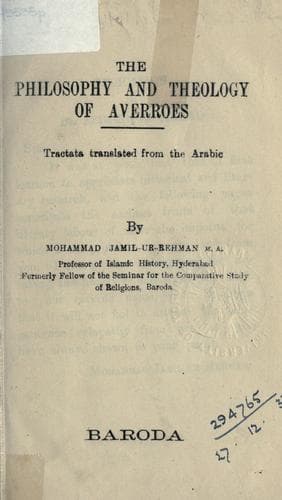
The Philosophy and Theology of Averroes — John Shaqi
The Philosophy and Theology of AverroesAverroës
ReligionIslamic
The Philosophy and Theology of Averroes
Averroës
Islam and philosophy; Philosophy, Arab
This is the statement of the doubt in the briefest terms possible, as
we have put it for your sake. A solution of this doubt requires a very
long discussion, but here we intend to state a point which might easily
solve it. Abu Hamid (Al Ghazzali) has also tried to solve this doubt in
his work: _The Refutation of the Philosophers_, but his method is by no
means satisfactory. For he says something to this effect: he thinks the
known and the knowledge are not connected with each other, so that when
a change takes place in the one the other does not change in itself. So
it is possible that it may happen in the case of Divine knowledge and
the things existent, that is, they may change in themselves while God’s
knowledge may remain the same. For instance a pillar may be on the
right hand of Zaid, it may be changed to his left without any change
taking place in Zaid himself. But the illustration is not at all a
correct one, for the relation has changed, that is, that which was on
the right side is now on the left. That in which no change has taken
place is the condition of that relation--Zaid. It being so, and the
knowledge is only the relation itself, it is necessary that it should
change with a change in the thing known, as the change in the relation
of the pillar to Zaid, for it is now on the left after being on the
right.
The view which might solve this question is that it should be
maintained that the condition of eternal knowledge of existent things
is quite other than the created knowledge with regard to them. For
the existence of a thing is the cause and means of our knowledge of
it, while the eternal knowledge is itself the cause and means of the
existent thing. So if a change takes place in the eternal knowledge
after the coming into being of an existent thing, as it does in the
created knowledge then it is involved that the former cannot be
the cause but only the effect of the existent things. Thus it is
necessary that there should be no change in it, as there is in the
created knowledge. This mistake always occurs by our taking eternal
knowledge to be like the created one, by an analogy from the seen
to the unseen. The error in this analogy has already been exposed.
Just as no change takes place in any agent after the creation of his
act--that is, change of kind which was not found before--so no change
in the eternal knowledge of God after the creation of the thing which
was in His knowledge. So this doubt is removed. At the same time it
is not necessary for us to say that as there is no change in eternal
knowledge, therefore, He does not know an existent at the time of
its creation, as it is. But we must believe that He knows not by a
created but by His eternal knowledge. For a change in knowledge with
a change of the existent thing is a condition of the knowledge which
depends upon the existent thing, such a knowledge being created. Thus
the relation of the eternal knowledge with the existent things is not
Public-domain text, read in full here on John Shaqi.
Reviews
Reviews
No reviews yet
Be the first to share your thoughts on this work.
Join the Discussion
Join the discussion
Sign in to leave a comment or review.
Sign InorCreate an account