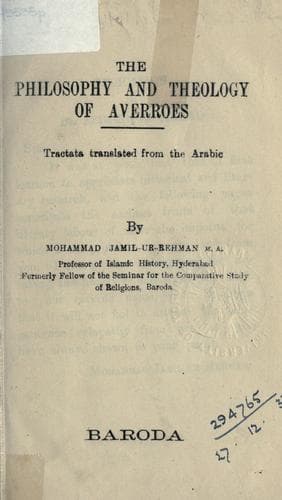
The Philosophy and Theology of Averroes — John Shaqi
The Philosophy and Theology of AverroesAverroës
ReligionIslamic
The Philosophy and Theology of Averroes
Averroës
Islam and philosophy; Philosophy, Arab
The _Asharites_ are of opinion that the verification of the existence
of God cannot be attained but by reason. But about this they have
adopted a method, which is not among the methods adopted by Law, and
is not mentioned in the Quran, nor the people invited through it to
believe. Their well-known method is founded upon the fact that the
universe is a created thing, which is itself based upon the theory
of the composition of atoms, and that the atom is a created thing,
and that other bodies are created out of it. The method which they
adopt for the exposition of the creation of an atom, which they call
_al-Jauharat u’l Faridah_ (sole Essence), is a misleading one even for
many religious men in the business of controversy, not to speak of the
common people. And despite this it is a method devoid of philosophy,
and does not lead to a belief in the existence of the Creator. For if
we suppose the universe is a created thing, it becomes necessary, as
they say, that its Creator must also be a “Created” object. But a doubt
presents itself about the existence of this created thing, which is
not in the power of scholastic theology to solve. And that is this,
that we can take this thing to be neither eternal nor created. For if
we take it as created, then it must require another created thing, and
this another, and so on to infinity. This is impossible. On the other
hand, if we take Him as eternal, then it is necessary that his action
in connection with the result must also be eternal. In this way the
results also become eternal. It is necessary for a created thing that
its existence be dependent upon a created action. Their hypothesis can
only be proved if they admit that a created action can be performed by
an eternal agent. For the result of the action might be dependent on
the action of the agent. But they do not admit it, for according to
their principles what is coeval with created things is itself created.
Moreover, if the agent sometimes acts and at other times remains
inactive, it is necessary, that there be a condition better applicable
in one state of things than in the other. Then about this condition
the same question will rise, and so it will go on till infinity. And
what the Mutakallimun say in answer to this objection that the created
action is the result of eternal intention, does not relieve us of our
doubt or satisfy our mind. For intention without action is dependent
upon the act, and if the act is a created thing, then it is necessary
that the intention in connection with it must also be a created thing.
It makes no difference whether we take the intention as eternal or
created, rising before the action or with it. So we may take it as
we like. All the same it is necessary for them to admit either of
the three things about the universe--either a created action, with a
created intention or a created action and an eternal intention, or
an eternal action with an eternal intention. But a created thing is
Public-domain text, read in full here on John Shaqi.
Reviews
Reviews
No reviews yet
Be the first to share your thoughts on this work.
Join the Discussion
Join the discussion
Sign in to leave a comment or review.
Sign InorCreate an account