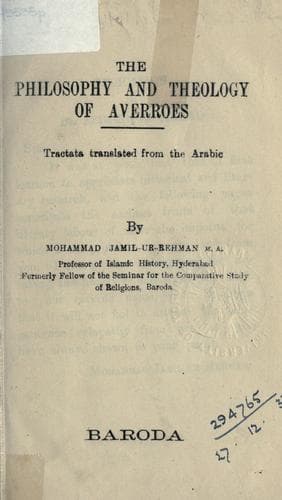
The Philosophy and Theology of Averroes — John Shaqi
The Philosophy and Theology of AverroesAverroës
ReligionIslamic
The Philosophy and Theology of Averroes
Averroës
Islam and philosophy; Philosophy, Arab
into other divisible quantities, or into indivisible ones. If it is
divided into indivisible ones then we have found particles which cannot
be divided. And if it is divided into other divisible parts, then again
the question arises whether these can be divided into divisible or
indivisible parts. So if it can be divided a limitless number of times,
there would be limitless particles in a limited thing. But it is one of
the primary principles of knowledge that particles in a limited thing
are limited.
Among the obscure doubts which can be attributed to the Asharites
is the question whether if an atom is brought into being, this is
different from creation itself, for it is one of the accidents? When
the created thing exists the act of creation is non-existent for
according to their principles, the accidents cannot be separated from
their essences. So this has compelled them to regard creation as
pertaining to the existent things and not for it. Then they may be
asked; if creation implies the non-existence of a thing, with what
is the act of the agent connected, for, according to them, there is
no mean between existence and non-existence. If this be so, and,
according to them, the action of the agent is connected neither with
non-existence, nor with that which is and nevertheless brings about an
existence, it must be connected with a middle substance. This doubt
has compelled the Mutazilites to say that there is a substance, even
in non-existence, which they call Matter or First Element. They should
admit that that which is non-existent can be made existent by action.
Both of these sects must also admit the existence of a void. These are
questions, which as you see, cannot be solved by dogmatics. Thus, it
is clear that such a method cannot be made a basis of the knowledge
of God, especially for the masses. We will shortly describe a clearer
method of knowing God.
Public-domain text, read in full here on John Shaqi.
Reviews
Reviews
No reviews yet
Be the first to share your thoughts on this work.
Join the Discussion
Join the discussion
Sign in to leave a comment or review.
Sign InorCreate an account