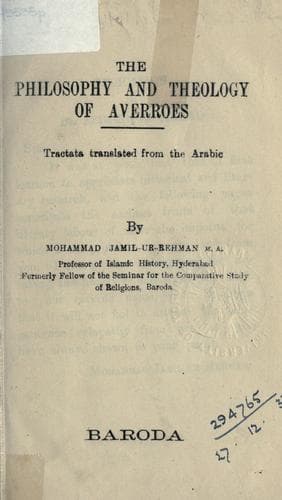
The Philosophy and Theology of Averroes — John Shaqi
The Philosophy and Theology of AverroesAverroës
ReligionIslamic
The Philosophy and Theology of Averroes
Averroës
Islam and philosophy; Philosophy, Arab
Now then if this is the method adopted by the Law, it may be asked:
What is the way of proving the unity of God by means of the Law; that
is, the knowledge of the religious formula that “there is no god, but
God.” The negation contained in it is an addition to the affirmative,
which the formula contains, while the affirmative has already been
proved. What is the purpose of this negation? We would say that the
method, adopted by the Law, of denying divinity to all but God is
according to the ordinance of God in the Quran, contained in the
following three verses. First, “If there were either in heaven or on
earth gods beside God, verily both would be corrupted.”[49] Secondly,
“God has not begotten issue; neither is there any other God with him;
otherwise every other God would surely take away that which he has
created; and some of them had enabled themselves over the others. Far
be it that from God, which they affirm of Him.”[50] Thirdly, “Say,
unto the idolators, if there were gods with Him, as ye say, they would
surely seek an occasion of making some attempt against the possessor of
the Throne.”[51] The argument contained in the first verse is implanted
in our dispositions by our very nature. For it is well-known that if
there be two kings, and the orders of the one be as effectual as those
of the other, it is not possible to have even a single city under their
guidance. It is impossible to have one action of a single kind from
two actors. So it is necessary that, if both of them begin work at the
same time, the city would be ruined, except in the case that one should
work and the other remain inactive. This is against our conception of
divinity. For when the two actions of the same kind are gathered upon
a single object, then that object must necessarily be destroyed. This
is the meaning of the verse, “If there were either in the heaven or on
earth gods besides God, both would be corrupted.” The verse, “Every god
has surely taken away that which he had created,” has been revealed in
refutation of the argument of those who believe in many gods, entrusted
with different works. For in this case it becomes incumbent that the
gods doing different works be independent of one another, and that they
should not be existent at one and the same time. But as the world is
one it is necessary that there be not in it gods with different duties.
The third verse, “Say unto the idolators if there were gods with him,
as ye say, they would surely seek an occasion of making some attempt
against the Possessor of the Throne,” is like the first, an argument
to prove the impossibility of the existence of two gods, whose duties
are the same. This verse means that had there been in the world any
other god, but the present one, able to create the world and those in
it, so that his relation to it be that of a creator, then he must live
with God on the Throne. Thus there would be found two existent things
of the same kind in a single place. But this is impossible.
Public-domain text, read in full here on John Shaqi.
Reviews
Reviews
No reviews yet
Be the first to share your thoughts on this work.
Join the Discussion
Join the discussion
Sign in to leave a comment or review.
Sign InorCreate an account