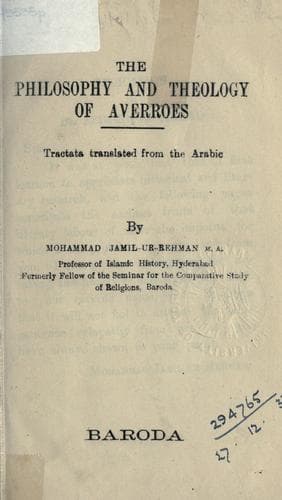
The Philosophy and Theology of Averroes — John Shaqi
The Philosophy and Theology of AverroesAverroës
ReligionIslamic
The Philosophy and Theology of Averroes
Averroës
Islam and philosophy; Philosophy, Arab
We hold it to be an established truth that if the Law is apparently
opposed to a truth proved by philosophy it admits of an interpretation
according to the canons of the Arabic language. This is a proposition
which a Muslim cannot doubt and a believer cannot mistrust. One who is
accustomed to these things divine can experience for himself what we
have said. The aim of this discourse is to bring together intellectual
and traditional science. Indeed, we would even say that no logical
conclusion will be found to be opposed to the Law, which when sifted
and investigated in its different parts will be found in accordance, or
almost so, with it.
* * * * *
That is why all Muslims are agreed that all the words of the Law are
not to be taken literally, nor all of them given an interpretation.
But they vary in verses, which are or are not to be interpreted.
For example, the Asharites put an interpretation upon the verse
of Equalisation[10] and on the Tradition of Descent,[11] while
the Hanbalites take them literally. The Law has made two sides of
these--exoteric and esoteric--because of the differences of human
nature and minds in verifying a thing. The existence of an opposed
esoteric meaning is in order to call the attention of the learned to
find out a comprehensive interpretation. To this the following verse
of the Quran refers: “It is he who hath sent down unto thee the book,
wherein are some verses clear to be understood--they are the foundation
of the book--and others are parabolical. But they whose hearts are
perverse will follow that which is parabolical therein, out of love of
schism, and a desire of the interpretation thereof; yet none knoweth
the interpretation thereof except God. But they who are well grounded
in knowledge say: We believe therein, the whole is from our Lord, and
none will consider except the prudent.”[12]
Public-domain text, read in full here on John Shaqi.
Reviews
Reviews
No reviews yet
Be the first to share your thoughts on this work.
Join the Discussion
Join the discussion
Sign in to leave a comment or review.
Sign InorCreate an account