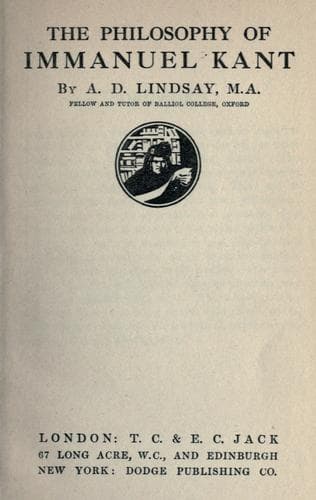
The Philosophy of Immanuel KantLindsay, A. D. (Alexander Dunlop)
Philosophy
The Philosophy of Immanuel Kant
Lindsay, A. D. (Alexander Dunlop)
Kant, Immanuel, 1724-1804
It will be easier to understand Kant’s arguments if we invert the order
of the _Critique_ and begin with examining the nature of the principles
of the understanding or of one of them.
The categories which are of importance in Kant’s argument are quantity,
quality, substance, causation, and reciprocity, and necessity,
possibility, and actuality. The last three are less important than the
others, and we shall not deal with them.
To the first five of these categories correspond the following
principles:
(1) Quantity. "All phenomena are, with reference to their perception,
extensive quantities."
(2) Quality. "In all phenomena the real, which is the object of a
sensation, has intensive quantity, that is, a degree."
The last three are classed under a general heading of _Analogies of
Experience_, whose principle is: "Experience is possible only through
the representation of a necessary connection of perceptions." They are
(3) _The principle of the permanence of substance_. "In all changes of
phenomena the substance is permanent, and its quantum is neither
increased nor diminished in nature."
(4) _Principle of the succession of time, according to the Law of
Causality_. "All changes take place according to the law of connection
between cause and effect."
(5) _Principle of co-existence, according to the law of reciprocity or
community_. "All substances, so far as they can be perceived as
co-existent in space, are always affecting each other reciprocally."
These principles, Kant points out, are assumed in the sciences of
applied mathematics. The application of geometry to the world we
experience assumes that all phenomena are extensive quantities; physics
assumes that quantitative expression can be given to the qualities of
objects other than their size, their weight, _e.g._, and all scientific
determination of change assumes the three principles which Kant calls
analogies of experience: the permanence or conservation of amount in
changes, the necessary connection of things in time, and the reciprocal
interdependence of things which exist at the same time. These
principles are not proved by science; their validity is assumed in all
scientific investigation. On what, then, does it rest?
Public-domain text, read in full here on John Shaqi.
Reviews
Reviews
No reviews yet
Be the first to share your thoughts on this work.
Join the Discussion
Join the discussion
Sign in to leave a comment or review.
Sign InorCreate an account