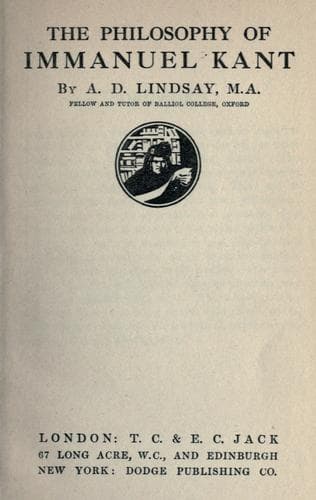
The Philosophy of Immanuel KantLindsay, A. D. (Alexander Dunlop)
Philosophy
The Philosophy of Immanuel Kant
Lindsay, A. D. (Alexander Dunlop)
Kant, Immanuel, 1724-1804
If we perceived nothing but change, we should be incapable
of distinguishing between our changes and the change outside us, for all
succession in our experiencing would be experience of what was
successive, and there could be no distinction between psychology and
science. Our experience of reality is not like either of these
suppositions, but like both of them combined. Some succession of our
experiencing is experience of the co-existing, some experience of
succession.
Reality stretches out beyond us in space, some of it changing and some
of it permanent; we cannot tell simply from the difference in what we
perceive whether the difference comes from change in us or change in the
thing. We can tell that only on the assumption that we are having
fragmentary views of a whole that is continuous. The only continuity we
know is the continuity of our own experience made possible by memory,
and we try to interpret that experience in the light of the larger
continuity of the world which our experience breaks up. As we go from
one place to another, notice now this thing, now that, we can test
interpretations made on this assumption. Wrong interpretations are
those which make our experience inconsistent. If we thought that what
happened at one time had no relation with what happened at another, that
anything might happen any time, our experience and our own life would be
the merest jumble. Our experience attains consistency only as we learn
more and more to disentangle the differences in experience which come
from our changes, from the changes and the variety which are part of the
whole connected system of reality, of which we see now one fragment,
then another. The distinction between succession in our apprehending
and apprehension of succession, which is the basis of all experience of
change, implies the recognition of change as not arbitrary but part of a
connected system of reality. As Kant puts it in his formulation of the
principle of the analogies of experience, "Experience is only possible
by means of the representation of a necessary connection of
perceptions."
Public-domain text, read in full here on John Shaqi.
Reviews
Reviews
No reviews yet
Be the first to share your thoughts on this work.
Join the Discussion
Join the discussion
Sign in to leave a comment or review.
Sign InorCreate an account