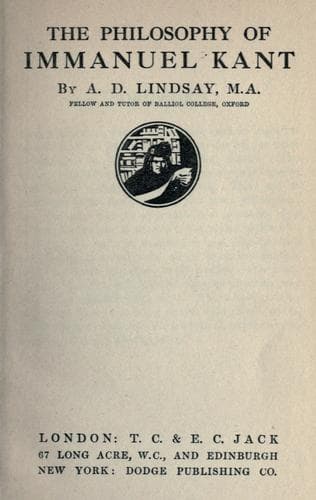
The Philosophy of Immanuel KantLindsay, A. D. (Alexander Dunlop)
Philosophy
The Philosophy of Immanuel Kant
Lindsay, A. D. (Alexander Dunlop)
Kant, Immanuel, 1724-1804
Immortality is the subject of what Kant calls the paralogisms of
rational psychology. He argues that all attempts to prove the
immortality of the soul by a priori arguments involve an argument of
this kind: they begin by noting that death is always dissolution of some
kind, that, therefore, what is not made up of parts and cannot be
dissolved, cannot die. Then they urge that the soul is not made up of
parts, and therefore cannot die. The fallacy in this argument is that
it treats the unity of the self as though it were an object of
knowledge. We can show that knowledge is only possible if the self has
a unity other than that of a spatial whole, but we cannot therefore
argue that it must be exactly like a spatial whole, in the sense that
death in it can only be brought about by dissolution, but unlike a
spatial whole in that in it there is nothing to be dissolved. The real
nature of the unity of the self, Kant argues, cannot be known. All we
can do is to reject a priori arguments either for or against its
immortality.
Freedom is treated in the third antinomy of pure reason, and to that
Kant devotes most attention, but others of the antinomies are concerned
with the difficulties arising from the application of spatial and
temporal determinations to reality as a whole, and to the category of
necessity. Kant makes a distinction between the first two and the
second two antinomies. It is the first two that express the inadequacy
of temporal or spatial determination to reality as a whole. All such
determination implies measurement, and measurement is always a relation
of part to part. The antitheses of both antinomies express the
inadequacy of any number to the expression of the nature of the whole,
the thesis the inadequacy of regarding reality as an aggregate or
addition of any kind. Each is strong in what it denies, and Kant’s
solution is that both thesis and antithesis are false, because you
cannot apply spatial or temporal determination to the world as a whole.
Public-domain text, read in full here on John Shaqi.
Reviews
Reviews
No reviews yet
Be the first to share your thoughts on this work.
Join the Discussion
Join the discussion
Sign in to leave a comment or review.
Sign InorCreate an account