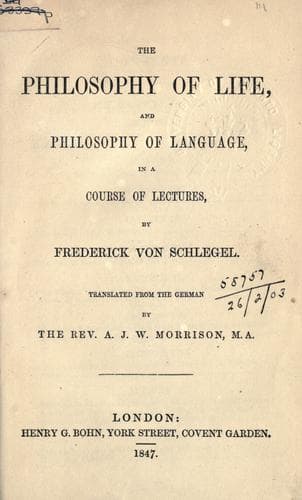
The philosophy of life, and philosophy of language, in a course of lecturesSchlegel, Friedrich von
Philosophy
The philosophy of life, and philosophy of language, in a course of lectures
Schlegel, Friedrich von
Language and languages -- Philosophy; Life; Philosophy
In order to demonstrate how essential is the co-operation of the will to
that living intercommunion with God, which is something more than a mere
understanding, we advance the following assumptions. Supposing that in
the incredible condescension of His love, God has made Himself known to
a man, just as in the first books of our Holy Scripture He is described
as conversing with Moses, and as familiarly as one friend talks to
another; supposing also that He revealed to him all the secret things of
heaven and earth without reserve; that He at the same time laid open to
him His will and hidden counsels, and that not summarily and in a
general way, but definitely and in detail--expressly making known to him
His gracious purposes, both in what He at present requires of him and
designs for him hereafter; that He has also pointed out to man the means
which will enable him to accomplish His will, and, moreover, has added
the highest possible promises for his encouragement; supposing all this,
is it not evident that it nevertheless could not help or profit man
unless he consented to receive it? The whole divine communication would
be in vain if man obstinately continued in his old Egoism, mixed and
compounded of evil habits, fears, and sensual desires, and, unable to
tear himself away, still clung close to the narrow limits of self and
his own Me.
Now it is nothing but this intrinsic consent and concurrence in the will
of God, this calm affirmation of it, that can help man, who is now left
to his own free determination even as regards the Deity, and that can
lead him to God. On this account I called the will, rather than the
understanding, man’s sense for the divine. But all that is here required
is the internal assent, and not the power of actual performance; for
that varies even according to the standard of nature, or rather of that
which is imparted to him from above, since of himself man has no
capacity for that which is higher and more excellent, nothing being
man’s own but his will. Now this internal assent and submission of man’s
own will to the divine is clearly inconceivable where it has not, to a
certain degree, withdrawn from the sensible world which surrounds him
with so many ties and allurements, and where it has not loosened and set
itself free from the narrow domain of self to which his Ego so closely
clings.
Public-domain text, read in full here on John Shaqi.
Reviews
Reviews
No reviews yet
Be the first to share your thoughts on this work.
Elsewhere in the archive
Join the Discussion
Join the discussion
Sign in to leave a comment or review.
Sign InorCreate an account