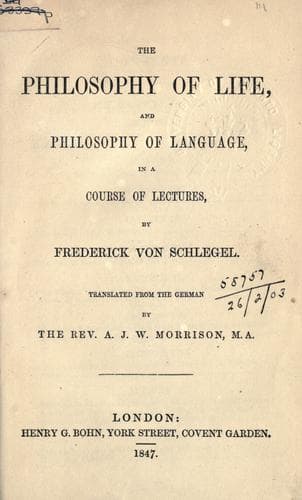
The philosophy of life, and philosophy of language, in a course of lecturesSchlegel, Friedrich von
Philosophy
The philosophy of life, and philosophy of language, in a course of lectures
Schlegel, Friedrich von
Language and languages -- Philosophy; Life; Philosophy
Here, then, naturally arises the question, how far a renunciation of the
world and self-sacrifice, on which even the Platonic philosophy so
greatly insisted, is necessary, if we would advance one degree, or at
least one step, nearer to God, as the supreme good and all-perfect
Being, and what are its true and proper limits? In obedience to this
idea of the renunciation of the world as indispensable to communion with
God, the Hindoo fakir will sit for thirty years in one spot, with his
eyes fixed immutably in the same direction, so that he not only
surpasses all the limits of human nature, but also erases and
extinguishes all traces of it in himself. Or perhaps, in spite of the
simple principle and rule of sound reason, that man, as he is not the
author of his own being, has no right to terminate it, he follows a
false idea of self-sacrifice, and mounts the flaming pile in order to be
the sooner united to the Deity. In the fundamental idea of these
extravagances there is doubtless a germ of beauty and of truth, though
in the perverse application and gigantic scale of exaggeration that we
meet with it among the primeval nations of Asia, it is distorted into
monstrous falsehood. A simple illustration, taken from the different
ages of man’s life, will perhaps serve to set in a clear light the point
on which every thing turns in this matter of the assent of the human to
the divine will, and to determine the sense and the degree in which man
ought not to give himself up entirely to the world, or to revolve
closely round the center of self, if he would yield a sincere and hearty
submission to a higher voice and that guiding hand which conducts the
education of the whole human race, and watches with equal care the
development of individuals and of ages. The child may and must play, for
such exercise is wholesome and even necessary for the free expansion of
its bodily powers; but at its mother’s call, for to the child hers is
the higher voice, it ought to leave its play. Youth, again, ought to be
merry and enjoy the verdant spring; but when honor and duty summon to
earnest action, then must he be ready to lay aside all light-hearted
amusement for sterner avocations; or to take another view of the
youthful temperament, should its joyousness touch too rudely, not to say
overstep, the bounds of morality, then at the first hint of warning it
must abandon its treacherous pleasures. The full-grown man, too, having
to make his way in the world and to fight with fortune in the hard
struggle of life, has little leisure for idle feelings and meditations;
only he must not renounce all higher and nobler sentiments, nor dismiss
from his mind the thought of the Godhead and the divine (which indeed
for its mere preservation requires no outward ordinance or loss of
time), as belonging to the boy, and suitable only for the unripe years
of youth. Or to regard life under its passive aspect, let us think of
Public-domain text, read in full here on John Shaqi.
Reviews
Reviews
No reviews yet
Be the first to share your thoughts on this work.
Elsewhere in the archive
Join the Discussion
Join the discussion
Sign in to leave a comment or review.
Sign InorCreate an account