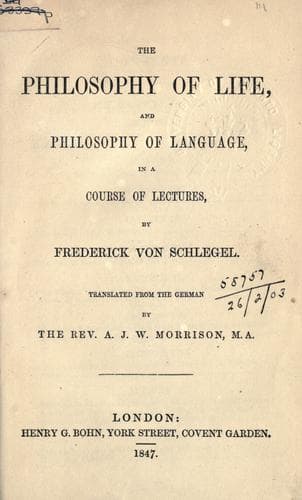
The philosophy of life, and philosophy of language, in a course of lecturesSchlegel, Friedrich von
Philosophy
The philosophy of life, and philosophy of language, in a course of lectures
Schlegel, Friedrich von
Language and languages -- Philosophy; Life; Philosophy
the happy wife by the side of a husband she loves, and living only in
her children, and possessing of worldly good as much as she wishes or
requires: suddenly, by one of those changes and chances which prevail in
this transitory life, she is bereaved of all--the partner of her joys
and cares, the children of her bosom, and perhaps, too, of her rank and
consideration, while beneath the repeated strokes of affliction her very
health sinks. Who would check her tears or blame her natural sorrow if
she feels and tells her woes? No one: for holier eyes than man’s look
upon her with compassion. One thing, however, may fairly and reasonably
be expected of her--that she do not give way entirely to despair, nor
murmur against Providence. More, therefore, than man requires of man in
the ordinary relations of life, God requires not of the human will; and
on that alone does He make any requisition, in respect to that free
assent and internal concurrence which alone can bind us in personal
union with the Godhead, and bring us near to Him; a consummation which
no mere intellectual apprehension of all possible revelations, whether
written on the pages of inspiration, or on the open tablets of nature,
or engraven on the imperishable annals of history, is sufficient to
bring about.
So much and nothing more is required for this essential concurrence of
the human will with the divine, in the general relations of life. But,
in the case of any special vocation and profession--if, for instance, a
man feels himself disposed to become a minister of the revealed Word, an
instrument and messenger of the divine communications--then, no doubt,
higher and sterner requisitions must come into consideration. To men of
native courage, what vocation can be more universal than that of a
soldier and defender of his country? but does not it require, besides
undaunted courage and contempt of death, the patient and enduring
fortitude which bears up under countless hardships and privations? What
vocation, again, can be simpler and more fully founded in nature, than
that of the softer sex to become a mother? but how many sufferings, and
fears, and dangers, compass it about, and how infinite are the great and
little anxieties to which a mother’s love--that purest and truest of all
earthly affections--is exposed? And it is even herein that human love
most betrays its weakness; it may suffice for some one determinate
direction, some transitory period of life, for some single effort of
magnanimity or self-sacrifice, but it rarely survives the changes of
time and fortune, and its faith and ardor too often are extinguished
amid the petty trials of every-day life, and its numberless cares and
anxieties.
Public-domain text, read in full here on John Shaqi.
Reviews
Reviews
No reviews yet
Be the first to share your thoughts on this work.
Elsewhere in the archive
Join the Discussion
Join the discussion
Sign in to leave a comment or review.
Sign InorCreate an account