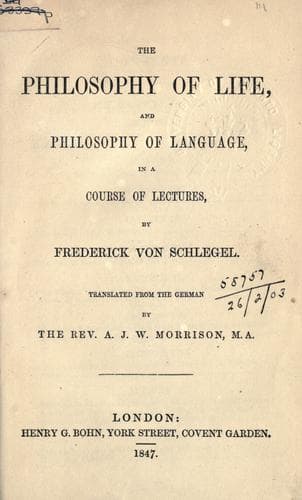
The philosophy of life, and philosophy of language, in a course of lecturesSchlegel, Friedrich von
Philosophy
The philosophy of life, and philosophy of language, in a course of lectures
Schlegel, Friedrich von
Language and languages -- Philosophy; Life; Philosophy
The longing after the eternal and divine, which has been already
described, is the seeking of God; but this calm, inward assent of the
will, whenever, with a childlike faith and enduring love, and in
steadfast hope, it is carried through and maintained with unwavering
fidelity throughout life, is the actual finding of Him within us, and a
constant adherence to Him when once we have found Him. As the root and
principle of all that is best and noblest in man, this divine longing
can not be too highly estimated, and nowhere is it so inimitably
described, and its excellence so fully acknowledged, as in Holy Writ
itself. A remarkable instance of it is the fact that a prophet who was
set apart and called by God Himself to his office, and was for that
purpose endued with miraculous gifts, is expressly called in Holy Writ
the man of longings.[27] And yet this longing is nothing but the source,
the first root, from which springs that triple flower in the lovely
symbol of faith, hope, and charity, which afterward, spreading over
every grade and sphere of moral and intellectual existence, expands into
the richest and most manifold fruits.
Now, it is very possible in some serious and intellectual work to feel a
pleasure in this triple union of holy thoughts and sentiments, as with
any deeply-significant picture in general, without duly entering the
while into its precise requisitions and profound meaning. But from one
particular end of a philosophy of life, _i.e._, of a thorough knowledge
of the human consciousness, the psychological aspect of the subject
assumes a peculiar importance, and essentially demands our attention.
With this view, I venture to assert that the human consciousness, which
otherwise and in itself is entirely a prey to discord, and split into
irreconcilable contraries, is, by faith, hope, and love, redeemed from
this dissension--is raised from its innate law, of an erring and dead
thought, and of an absolute will, which is no less dead and null, being
restored gradually to a perfect state of unison and harmony. Under the
influence of faith--and by this term I understand, not the cold and
heartless repetition of a customary formulary, but a living and personal
faith in a living and personal God and Savior--under the influence of
such a faith, the living spirit of truth steps into that place of the
consciousness which before was usurped by the mere abstract thinking of
a degraded understanding. And whenever, on the other hand, a refined
goodness and love have in patient endurance become the soul of
existence, there is no room for the stormy obstinacy or passionate
wildness of an absolute will. Even in the will itself all is now life;
discord is banished from it, and all the threatening elements of strife
are forever appeased. And in that trusting confidence with which the
loving soul leans upon God--in the strong godlike hope which takes its
stand upon the Eternal, the reason, with its ordering, regulating, and
Public-domain text, read in full here on John Shaqi.
Reviews
Reviews
No reviews yet
Be the first to share your thoughts on this work.
Elsewhere in the archive
Join the Discussion
Join the discussion
Sign in to leave a comment or review.
Sign InorCreate an account